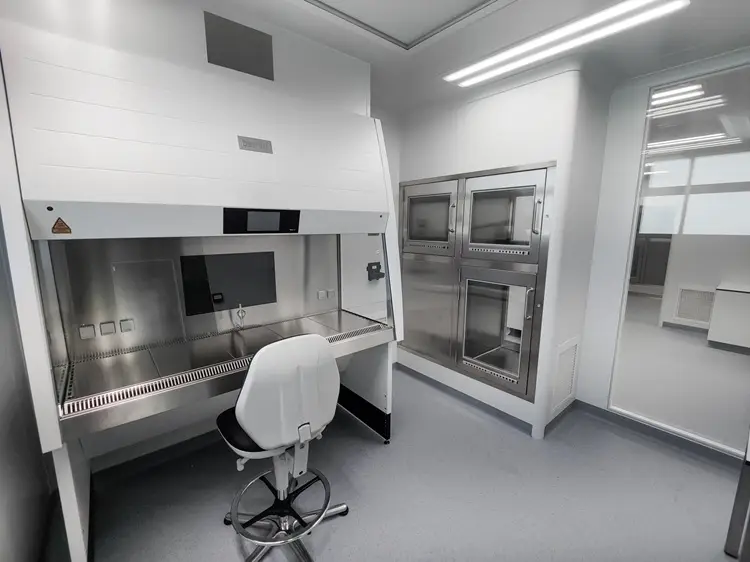
A hardwall cleanroom is built from rigid, sealed wall and ceiling panels, while a softwall cleanroom uses flexible vinyl curtains hung from a frame with fan filter units on top. Hardwall rooms suit higher cleanliness classes, pressure cascades and GMP production. Softwall enclosures are cheaper, faster to set up and easier to move, which makes them a good fit for less demanding processes and temporary needs.
The wall type alone does not decide the cleanroom class. Classification under ISO 14644-1 depends on the complete system: filtration, airflow, pressure control, people, equipment and how the room is operated. This guide compares both options and explains when each one makes sense.
What is a hardwall cleanroom?
A hardwall cleanroom is an enclosed room made of rigid panels, typically sandwich panels with a smooth, cleanable finish, combined with a sealed ceiling grid, flush doors and integrated services. The panels can be part of a modular system, a freestanding enclosure inside an existing building, or a conventionally built room finished on site.
Because joints, doors and service penetrations can be sealed, a hardwall room gives a well defined boundary. That boundary makes it possible to control the air volume leaving the room and to hold a stable pressure difference against adjacent spaces. It also supports the surface requirements of EU GMP Annex 1, which asks for smooth, impervious and unbroken surfaces that limit particle shedding and withstand repeated cleaning and disinfection.
Hardwall rooms are the usual choice for pharmaceutical production, ATMP manufacturing, medical device assembly and semiconductor processes where tight environmental control and documented validation are required.
What is a softwall cleanroom?
A softwall cleanroom is a framed enclosure with flexible vinyl or PVC curtains on the sides and fan filter units in the ceiling. Filtered air is pushed down through the work zone and escapes under or between the curtains, so the enclosure relies on a constant outflow of air rather than a sealed boundary.
Softwall enclosures are quick to install, need little building work and can be moved, extended or removed with minimal effort. They are often placed around a single machine, a packaging line or an inspection bench inside a larger hall, or used as a temporary clean zone during a renovation or a capacity peak.
The open perimeter is also the main limitation. Without a sealed boundary, holding a defined pressure difference against the surrounding room is difficult, and curtains are harder to clean and disinfect to GMP standards than smooth rigid panels.
Hardwall vs softwall cleanroom
| Criterion | Hardwall cleanroom | Softwall cleanroom |
|---|---|---|
| Walls | Rigid, sealed panels | Flexible vinyl or PVC curtains on a frame |
| Room boundary | Sealed joints, doors and penetrations | Open perimeter, air escapes at the curtains |
| Pressure control | Stable pressure cascades between rooms | Limited, relies on constant outflow |
| Typical use | GMP production, higher cleanliness classes, multi room suites | Single process zones, less demanding classes, temporary needs |
| Cleanability | Smooth surfaces suited to repeated disinfection | Curtains harder to clean to GMP standards |
| HVAC | Integrated with an air handling unit and building systems | Mostly fan filter units drawing room air |
| Installation time | Longer, especially with full HVAC and validation | Fastest of all cleanroom types |
| Flexibility | Reconfigurable when modular, fixed when built on site | Easy to move, extend or remove |
| Upfront cost | Higher | Lowest of all cleanroom types |
Sources: Lab Manager, ISPE, EU GMP Annex 1.
Classification, pressure and GMP requirements
ISO 14644-1 classifies cleanrooms by airborne particle concentration, and ISO 14644-4 covers their design, construction and start up. Neither standard prescribes a wall type. A softwall enclosure can reach a given ISO class under the right conditions, but the result has to be shown by testing the complete installation, not assumed from the product name.
The difference becomes clear with pressure. EU GMP Annex 1 asks for a minimum pressure difference of 10 pascals between adjacent rooms of different grades, with critical pressure differences continuously monitored and alarmed. The ISPE good practice guide for HVAC adds that 5 pascals between rooms of the same class is the minimum for robust separation. Holding these values depends on controlling every leakage path, from door gaps and wall openings to cracks in the ceiling system, which is only practical with a sealed, rigid boundary.
For GMP grade A to C production, sterile manufacturing and cell and gene therapy, hardwall construction is therefore the standard choice. Softwall enclosures are better suited to non GMP work, ISO classified zones without a pressure cascade, and local protection of a process inside an already controlled room.
Cost, speed and flexibility
Softwall enclosures have the lowest purchase price and the shortest installation time of all cleanroom types, because they consist of a frame, curtains and fan filter units with little connection to the building. Hardwall cleanrooms cost more upfront, as they include rigid panels, sealed doors, a ceiling system and usually a dedicated HVAC installation.
The purchase price says little about the total cost, however. A fair comparison includes installation, disruption to ongoing operations, energy use, qualification, and the changes expected over the life of the room. A softwall enclosure that has to be replaced by a hardwall room once a process moves into GMP production often ends up as the more expensive route.
Flexibility depends more on the construction method than on the wall type. Modular hardwall panel systems can be reconfigured, extended or relocated, while a hardwall room built on site stays fixed. When a process is expected to grow or change, a modular hardwall system combines the control of rigid walls with much of the adaptability of a softwall enclosure. More detail on budgets is in the guide on how much it costs to build a cleanroom, and the trade offs of modular construction are covered in modular cleanrooms: advantages and comparison.
When to choose hardwall or softwall
The choice follows from the process requirements, not the other way round. Starting with the required class, the GMP status and the expected lifetime of the process usually makes the answer clear.
A hardwall cleanroom is the better fit when:
- the process falls under EU GMP or requires a defined pressure cascade between rooms
- the room needs strict temperature and humidity control
- several rooms, airlocks and gowning areas have to work together
- surfaces must withstand frequent cleaning and disinfection
- the facility will be used for many years
A softwall cleanroom is the better fit when:
- the process needs local protection inside an already clean or controlled hall
- no pressure cascade or GMP grade is required
- the space is needed quickly or only temporarily, for example during a renovation
- the layout is expected to move or change often
When the requirements sit in between, or a pilot process is expected to grow into regulated production, a modular hardwall system is often the most sensible middle ground.
Rigid walls without a fixed layout
ABN Cleanroom Technology builds hardwall cleanrooms through Configure-to-Order+ (CTO+), a system of pre-engineered and validated building blocks for walls, ceilings, doors and HVAC. Each project is configured from these blocks to match the class, pressure cascade and process flow it actually needs. This gives the sealed boundary and cleanable surfaces that GMP production requires, while the modular build keeps the room open to later extension or reconfiguration as a process grows.
Häufig gestellte Fragen
What is the difference between a hardwall and a softwall cleanroom?
A hardwall cleanroom has rigid, sealed panels and a closed boundary, which allows stable pressure control and GMP compliant surfaces. A softwall cleanroom uses flexible curtains on a frame with fan filter units, which makes it cheaper and faster to install but less suited to pressure cascades and higher grade work.
Can a softwall cleanroom meet an ISO class?
Yes, a softwall enclosure can reach an ISO 14644-1 class when the filtration, airflow and operation are designed for it. The class has to be confirmed by testing the complete installation, as the wall type alone does not determine it.
Is a softwall cleanroom suitable for GMP production?
Rarely. EU GMP Annex 1 requires a pressure difference of at least 10 pascals between rooms of different grades and smooth, cleanable surfaces. Both are difficult to achieve with curtains and an open perimeter, so GMP grade A to C areas are normally built as hardwall rooms.
Which is cheaper, hardwall or softwall?
Softwall has the lower purchase price and the faster installation. Over the full life of a room, total cost also depends on energy, qualification, disruption and later changes, so the cheapest option to buy is not always the cheapest to own.
Can a hardwall cleanroom be moved or extended?
Yes, when it is built from a modular panel system. Modular hardwall rooms can be reconfigured, extended or relocated, while hardwall rooms built conventionally on site are fixed.
Sources
- ISPE, “Room differential pressures in facility design: fundamentals” (Pharmaceutical Engineering, July/August 2024): ispe.org. Used for the Annex 1 minimum of 10 Pa between grades, monitoring and alarms, the 5 Pa minimum between rooms of the same class, and the leakage paths.
- Lab Manager, “Modular vs. conventional cleanrooms: cost, speed, and flexibility” (2026): labmanager.com. Used for softwall having the lowest cost and fastest install, rigid rooms suiting pressure cascades, modular flexibility and lifecycle cost.
- Labs USA, “Hardwall cleanroom vs softwall cleanroom: a buyer’s guide” (2026): labs-usa.com. Used for the point that wall type alone does not determine the ISO class.
- ISO 14644-1:2015, Classification of air cleanliness by particle concentration: iso.org
- ISO 14644-4:2022, Design, construction and start-up: iso.org
- EudraLex Volume 4, EU GMP Annex 1 (2022), clauses 4.6, 4.14 and 4.16: health.ec.europa.eu. Used for the surface requirements, the pressure difference and the monitoring.