



ISO 6 cleanroom: requirements, particle limits and typical applications
What is an ISO 6 cleanroom?
An ISO 6 cleanroom sits between the ultra-clean ISO 5 environments used for critical processes and the more common ISO 7 and ISO 8 spaces used for general controlled manufacturing. It is defined by ISO 14644-1, the international standard that sets particle limits for cleanroom classification. Get the classification decision wrong here and you either overpay for air you don’t need, or under-build a room that can’t hold its own numbers.
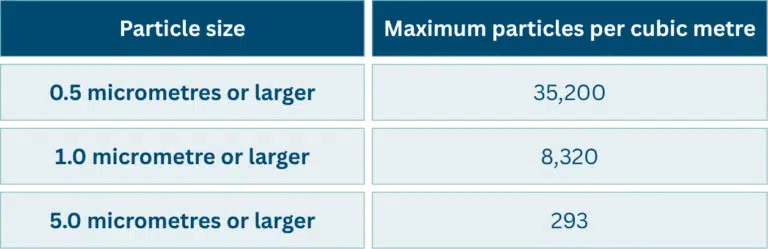
ISO 14644-1 sets a maximum particle count for each cleanroom class. For ISO 6, the air may contain no more than:
Air changes per hour
An ISO 6 cleanroom typically needs 150 to 240 air changes per hour, delivered through HEPA or ULPA filtered air. Airflow is usually turbulent (mixed) rather than unidirectional, which is the airflow pattern reserved for stricter classes such as ISO 5. The exact air change rate depends on room size, the number of people working inside, and how often materials or equipment move in and out. A higher rate of activity generally calls for a higher air change rate to keep particle counts within limits.
Beyond fixed air change rates
A fixed table like the one above tells you the ceiling. It doesn’t tell you what your specific room actually needs, and that gap is where most cleanrooms lose money in one direction or the other.
At ABN Cleanroom Technology, air change rates aren’t pulled from a fixed table at all. Through computational fluid dynamics (CFD) and lifecycle-based simulation, ABN calculates the actual air change rate a room needs, based on how much particle load the process generates, how often doors open, and how fast the room has to recover after a disturbance. That avoids the two failure modes a fixed-rate approach always risks: underdesign, where the room can’t keep up with real activity, and overdesign, where energy gets spent maintaining an air change rate the process never needed.
That second failure mode is more expensive than most people assume. Cleanrooms already consume up to 25 times more energy per square metre than non-classified space, and HVAC alone accounts for 50 to 75% of a cleanroom’s total electricity use. An air change rate set one notch too high, multiplied across a room running 24/7, adds up fast.
How ISO 6 compares to ISO 5 and ISO 7
- ISO 5 allows far fewer particles and is used for the most contamination sensitive steps, such as final assembly of critical medical devices or aseptic filling.
- ISO 6 allows more particles than ISO 5 but fewer than ISO 7. It is often used as a buffer or gowning zone around an ISO 5 space, and directly for processes that need tight control without full ISO 5 requirements.
- ISO 7 is the most commonly specified class for general GMP and medical device manufacturing, with a higher particle allowance than ISO 6.
Typical applications
ISO 6 cleanrooms are common in:
- Semiconductor manufacturing, particularly photolithography and wafer handling, where even sub-micron particles cause defects
- Gowning rooms and airlocks that protect an adjacent ISO 5 space from contamination during personnel or material transfer
- Medical device manufacturing steps that require tighter control than ISO 7 but not full ISO 5 conditions
- Precision electronics and optics assembly
Gowning rooms and airlocks deserve a closer look, because they’re where ISO 6 rooms are put under the most repetitive stress. Every person and every cart that passes through is a small pressure and particle event, dozens of times a shift. The Dynamic Speed Interface (DSI) is built for exactly that: it reads particle concentration, pressure differential and door activity in real time, and adjusts airflow on the fly to cut recovery time between events, without ever breaking the pressure hierarchy that keeps contamination moving the right direction. The result is an airlock that spends less energy holding its classification when nobody’s walking through it, and reacts faster when someone is.
How ABN approaches this
ISO 6 rooms used to mean designing from scratch every time: a new layout, a new airflow calculation, a new set of trade-offs between speed, cost and reliability, redone for every client. That’s the Engineer-to-Order model most of the cleanroom industry still runs on, and it’s slow precisely because nothing carries over from one project to the next.
At ABN, ISO 6 environments are designed through the Configure-to-Order+ (CTO+) approach instead. That’s only possible because of ADAPTUS, ABN’s product platform for cleanroom engineering: a library of pre-engineered, validated building blocks, covering air handling units, wall panel systems, filtration modules and more, that already meet the airflow, pressure cascade and monitoring requirements an ISO 6 classification demands. Instead of re-deriving those requirements on paper for every project, ABN configures a room from parts that have already proven they meet them.