



What is an ISO 5 cleanroom? Standards, requirements and typical applications
An ISO 5 cleanroom is a highly controlled environment designed to keep airborne particle levels extremely low. In practice, it is used where product exposure creates a high contamination risk, such as aseptic filling, sterile compounding, sensitive assembly and other critical operations. Under FDA guidance, ISO 5 corresponds to a maximum of 3,520 particles of 0.5 µm and larger per cubic meter, and it is broadly comparable to EU Grade A in aseptic applications.
Why ISO 5 matters?
ISO 5 matters because it is one of the strictest cleanroom classifications, designed to keep airborne particles at extremely low levels for processes where even tiny contamination can cause failures or safety risks. It is especially important in pharmaceuticals, medical devices, semiconductors, biotechnology, optics and aerospace.
When a product, component, or critical surface is exposed, the surrounding air becomes part of the process. That is why ISO 5 is used in operations where contamination control cannot be left to chance. FDA guidance describes the ISO 5 area as the critical area for exposed sterile product, containers, and closures, while EU GMP Annex 1 places key aseptic operations in Grade A environments.
Put simply, ISO 5 is used when dust, microbes, or microscopic particles could ruin a wafer, compromise a sterile product or affect research results.
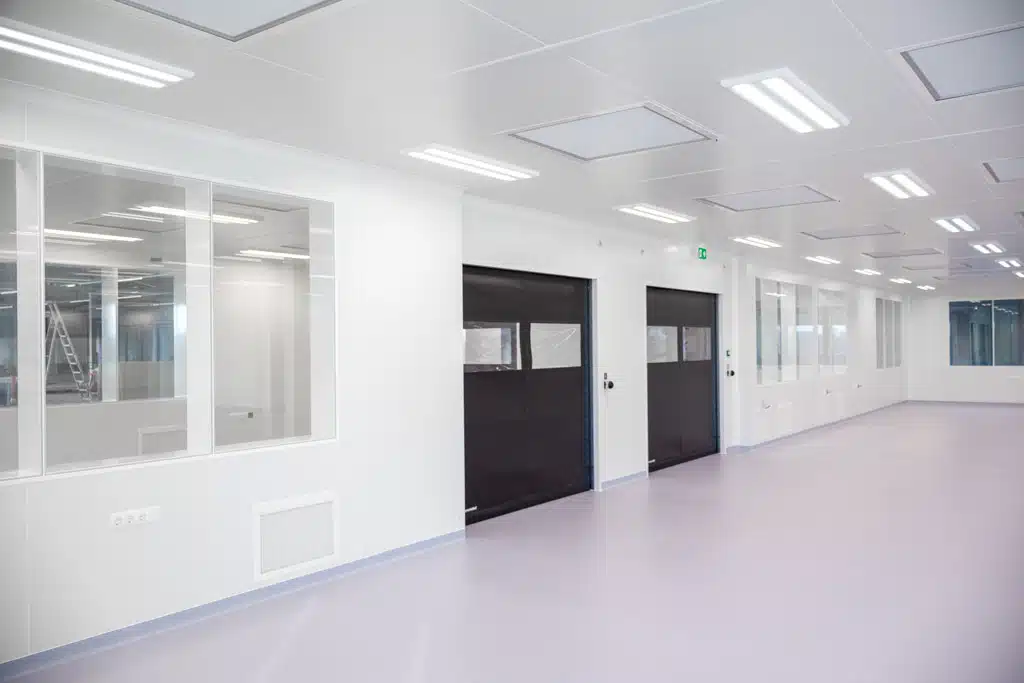
What defines an ISO 5 cleanroom?
At its core, ISO 5 is defined by particle concentration. The commonly referenced limit is maximum 3,520 particles/m3 at 0.5 um and larger. For sterile applications, that clean air is typically delivered through HEPA filtration and carefully controlled airflow. CDC guidance states that HEPA filters are at least 99.97% efficient for particles 0.3 um and larger.
In many critical processes, ISO 5 protection also relies on unidirectional airflow. FDA guidance recommends demonstrating airflow that sweeps over and away from the product, while EU GMP Annex 1 says unidirectional systems should deliver a homogeneous air speed of 0.36 to 0.54 m/s, unless another approach is scientifically justified.
ISO 5 cleanroom requirements in practice
Meeting ISO 5 is not only about filtration. It depends on how the full environment is designed, qualified and operated. This is where the approach to cleanroom delivery matters. We use a system architecture built from pre-engineered and validated building blocks with known performance characteristics, so compliance requirements like ISO 5 can be embedded from the start rather than engineered separately for each project. Think of:
- Air cleanliness
The room or protected zone must maintain ISO 5 particle limits at the relevant point of use. In aseptic environments, measurements should be taken close to the exposed work area, where contamination risk is highest. - HEPA-filtered air supply
High-efficiency filtration is essential to reduce airborne contamination and support stable cleanroom performance. - Unidirectional airflow
For critical aseptic zones, airflow should protect the product by sweeping particles away from the working area. Both FDA and EU GMP guidance emphasize airflow visualization and verification, not just theoretical design values. - Background environment
An ISO 5 zone often sits within a broader cleanroom concept. FDA recommends at least ISO 7 for the area immediately adjacent to an aseptic processing line, while EU GMP Annex 1 states that Grade B serves as the background for Grade A when an isolator is not used. - Monitoring and qualification
A cleanroom must be qualified both at rest and in operation. Annex 1 defines these states clearly and expects the manufacturer to document how the room returns to qualified cleanliness after operations or disruption. - People and process discipline
Even a well-designed ISO 5 environment can be compromised by poor operator behavior, poor maintenance or weak procedures. FDA explicitly warns that unidirectional airflow can be disrupted by movement and improper interventions.
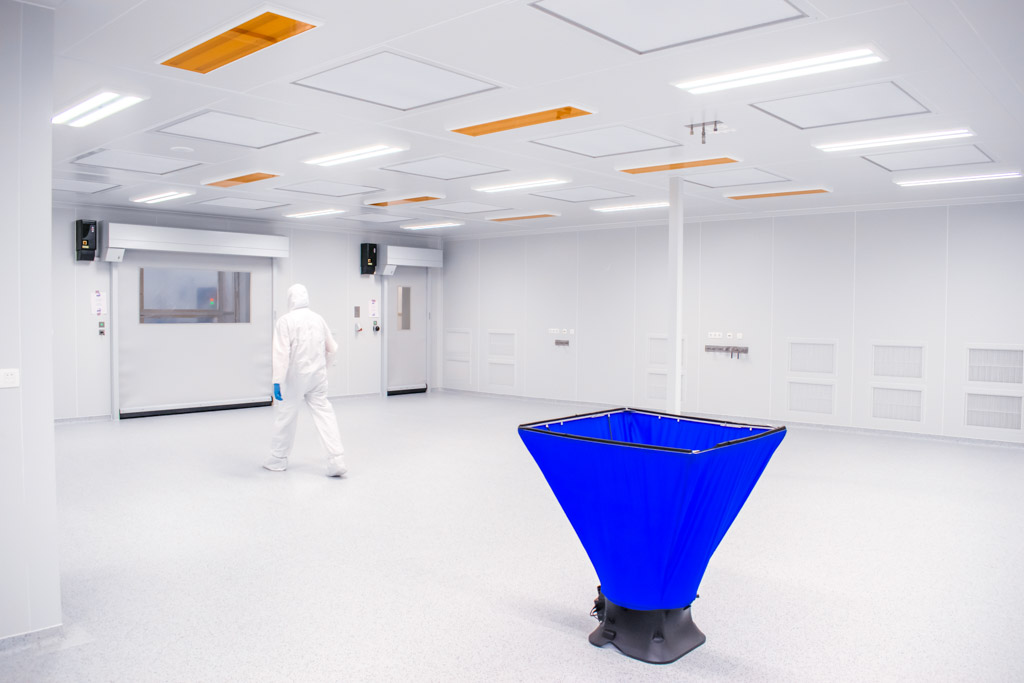
Is ISO 5 the same as sterile?
No. ISO 5 refers to air cleanliness, not guaranteed sterility.
That distinction matters. A room can meet ISO 5 particle limits and still fail to protect the process if airflow is disturbed, interventions are poorly controlled, cleaning is inconsistent, or monitoring is weak. In sterile manufacturing, regulators therefore look beyond classification alone to the full contamination control strategy, including room design, operator practices, environmental monitoring, and process discipline.
Where are ISO 5 cleanroom typically used for?
ISO 5 cleanrooms are common in industries where exposed product or sensitive assemblies cannot tolerate contamination. Typical examples include:
- Pharmaceutical and biotech aseptic processing
- Sterile compounding and filling
- Medical device manufacturing
- Life sciences and laboratory applications
- High-precision electronics or optical assembly, depending on the process requirement
In sterile manufacturing specifically, Annex 1 lists operations such as aseptic compounding, aseptic filling, sterile connections, and lyophilizer loading in Grade A conditions.
What makes ISO 5 more demanding than lower ISO classes?
As cleanroom classification becomes stricter, the design burden increases. More filtration, more controlled airflow, tighter construction, more robust monitoring and stronger operational discipline are all needed to maintain the target environment. Higher classifications such as ISO 5 require more stringent air cleanliness levels and therefore more filtration and airflow. This is why ISO 5 should never be treated as a generic room label. It is a performance requirement that affects the full project lifecycle: design, build, qualification, operation, maintenance and energy use. ABN’s Configure-to-Order Plus approach is particularly well-suited to managing these demands consistently across projects.
Design consederations for choosing ISO 5
Before specifying ISO 5, it helps to answer a few practical questions:
- Is the product exposed, and for how long?
- Is the critical zone open, protected by UDAF, or enclosed in an isolator?
- What background classification is required?
- What level of monitoring and qualification will the process demand?
- How will maintenance be performed without disrupting uptime or compliance?
What are the long-term energy and lifecycle implications?
The right answer is rarely “just make it ISO 5.” The better answer is to define the process risk first, then engineer the cleanroom concept around it. At ABN Cleanroom Technology, these questions are answered before configuration begins. The Configure-to-Order Plus (CTO+) framework defines value priorities and Olympic Minimum levels upfront, ensuring that ISO 5 requirements are embedded in the system architecture rather than resolved project by project.
Final thoughts
An ISO 5 cleanroom is used where contamination control is critical and the process leaves little room for error. It requires far more than a HEPA filter and a classification label. Real ISO 5 performance depends on the full system: airflow design, filtration, background environment, qualification, monitoring and disciplined operation. For companies working in regulated or mission-critical environments, the goal is not only to achieve ISO 5 on paper, but to maintain it reliably in daily operation. That is precisely the ambition behind ABN’s Configure-to-Order Plus approach: cleanrooms that are configurable without compromise, with ISO 5 performance protected by design rather than managed case by case.