



Optimizing cleanroom airlock design: Adaptive performance through Dynamic Speed Interface (DSI)
Cleanroom airlocks play a decisive role in maintaining contamination control and operational continuity in pharmaceutical, biotech and high-tech manufacturing environments. Although often perceived as simple transitional zones between classified spaces, airlocks are in fact dynamic interfaces that protect pressure cascades, regulate particle migration and manage the operational flow of personnel and materials. Their design directly influences recovery performance, energy consumption, ergonomic comfort and ultimately regulatory compliance.
Traditionally, airlocks have been engineered as isolated project components, designed from scratch for each new facility. This approach, while once common, no longer reflects the needs of modern cleanroom design. Airlock design today is no longer about reinventing a space in every project; it is about configuring proven performance modules in a predictable and reliable way.
In modern facilities, increasing production intensity and higher personnel throughput place additional demands on airlock performance. Conventional static design approaches, which rely on fixed airflow volumes and conservative recovery assumptions, frequently lead to overdimensioned systems that consume excessive energy while simultaneously creating workflow inefficiencies. A configuration approach on the contrary, offers so much more advantages.
From custom airlock design to configuration
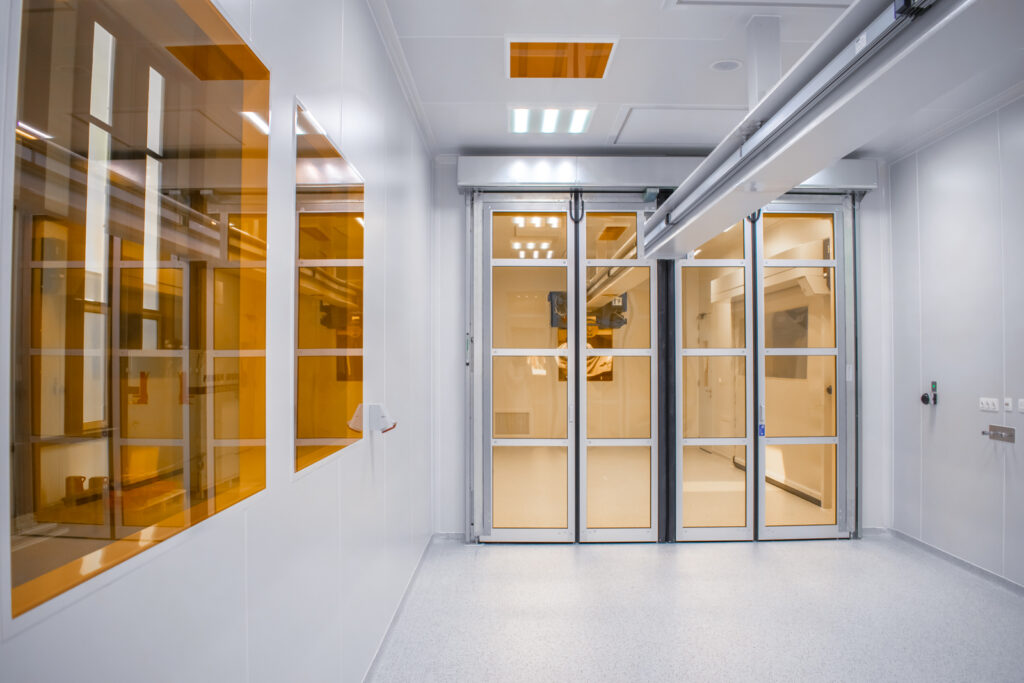
An airlock must be understood as a contamination control interface rather than merely a buffer space. Its primary function is to prevent the uncontrolled transfer of airborne particles between adjacent cleanroom classifications while maintaining the integrity of the pressure cascade.
Human operators represent the most significant contamination source within a cleanroom environment. Even under appropriate gowning conditions, particle emission remains unavoidable, particularly during movement, garment adjustments and door transitions. The airlock, typically ISO 8 or ISO 7, must be engineered to manage these contamination bursts efficiently without compromising the classification of the connected cleanroom.
In conventional cleanroom projects, airlocks are often designed entirely from zero, with airflow rates, pressure cascades and recovery parameters recalculated for each facility. While technically feasible, this approach introduces variability, extended engineering timelines and a higher probability of design errors.
Airlock design today is no longer about reinventing a space in every project; it is about Configure-to-Order: configuring proven performance modules in a predictable and reliable way.
Jo Nelissen, CEO ABN Cleanroom Technology
Modern airlock and cleanroom engineering demands a different mindset. “Configuration, rather than redesign, is now the key principle. By working with validated building blocks that have defined performance characteristics, airlocks can be assembled as configurable modules tailored to the client’s processes,” says Jo Nelissen, CEO of ABN Cleanroom Technology.
This configurational strategy delivers clear advantages to the end user. Engineering time is reduced because proven modules replace repeated calculation cycles. The risk of design errors decreases because performance parameters are predefined and validated. Reliability improves because each building block operates within established boundaries. Most importantly, project timelines accelerate while maintaining predictable environmental performance.
Instead of starting from a blank sheet in every project, the design process begins with understanding the client’s process requirements and configuring the appropriate functional blocks accordingly.
Particle emissions caused by human behaviour in a Personnel Airlock (PAL)
One of the most critical parameters in airlock design is occupancy rate. The number of personnel entering and exiting per hour directly determines particle load, door cycle frequency and pressure fluctuation amplitude. Human beings are the dominant source of particulate contamination in controlled environments. Even when properly gowned, operators continuously emit particles through skin desquamation, micro-movements of garments and air displacement caused by body motion. In a Personnel Airlock (PAL), where gowning activity and door transitions occur, this emission effect is amplified.
Designing based on average occupancy is insufficient. In a Personnel Airlock, these emission peaks occur in short but intense bursts. Unlike steady-state contamination in a production zone, the PAL is characterized by transient contamination events. The ventilation system must therefore be capable of rapidly diluting these bursts and restoring acceptable cleanliness levels within a short recovery window.
High personnel throughput increases the frequency of contamination events and shortens the available recovery window between successive door openings. Therefore, air change rates, airflow distribution and extract strategies must be dimensioned to handle dynamic rather than static load conditions.
However, simply increasing airflow volume is not a sustainable solution. Oversized systems generate higher energy consumption, elevated noise levels and uncomfortable draft conditions for operators.

Aligning airlock configuration with process reality: a Configure-to-Order+ approach
The optimal airlock design can only be determined by briefly analysing the client’s actual processes. “Therefore, we observe the operational flow, gowning procedures and personnel movement patterns, says Jo Nelissen. By doing so, the required performance envelope becomes clear.”
Three parameters are particularly decisive: particle generation load, frequency of door openings and required recovery time. These factors vary considerably between facilities. A research laboratory with limited personnel traffic differs fundamentally from a high-volume sterile manufacturing site with frequent gowning transitions.
By mapping these process characteristics, the appropriate building blocks can be configured to match the real contamination dynamics. This ensures that airflow capacity, pressure cascade stability and recovery acceleration are dimensioned precisely according to operational demand rather than theoretical worst-case assumptions. Such an approach avoids both underdimensioning, which risks compliance instability, and overdimensioning, which leads to unnecessary energy consumption and discomfort.
Dynamic Speed Interface introduces algorithm-driven airflow modulation that reduces recovery time, enhances operator efficiency and improves energy performance while maintaining full pressure hierarchy.
Jo Nelissen, CEO ABN Cleanroom Technology
Ergonomics versus efficiency
Traditional airlock designs often rely on fixed airflow setpoints and predetermined waiting times after door openings. While this conservative approach supports compliance, it can create significant operational inefficiencies. In facilities with high personnel turnover, mandatory waiting periods of 60 to 120 seconds per entry can accumulate into substantial productivity losses.
Moreover, constant high airflow generates increased acoustic disturbance and draft discomfort, negatively affecting operator well-being. In sterile manufacturing environments where personnel remain in classified zones for extended periods, ergonomic comfort becomes a significant factor in maintaining consistent performance. The challenge lies in reconciling strict contamination control requirements with operational efficiency and user comfort. Static ventilation strategies struggle to resolve this dilemma because they cannot differentiate between actual contamination load and theoretical worst-case scenarios.
Dynamic Speed Interface: Algorithm-driven airflow modulation
To address these limitations, the Dynamic Speed Interface (DSI) concept introduces adaptive intelligence into airlock ventilation control. Instead of operating at fixed airflow volumes regardless of environmental conditions, DSI dynamically adjusts ventilation performance in response to real-time data.
Jo Nelissen further explains: “The principle behind DSI is straightforward yet technologically advanced. Environmental parameters such as particle concentration, pressure differential stability and door activity are continuously monitored. Intelligent algorithms analyse this data and determine the optimal ventilation response. Once recovery is achieved, airflow is reduced to a stable baseline level.”
This adaptive modulation significantly reduces recovery time compared to conventional fixed-speed systems. Operators can proceed more rapidly into the cleanroom without compromising contamination control. Furthermore, adaptive airflow avoids continuous over-ventilation. In the traditional scenario, airflow remains fixed at a level designed for peak particle emission, even when the airlock is unoccupied.
In the DSI scenario, ventilation intensity matches actual demand. This demand-driven behaviour reduces fan energy consumption and associated heating or cooling loads.
Jo Nelissen, CEO ABN Cleanroom Technology
Recovery time optimization
Recovery time represents a crucial performance indicator for airlocks. It defines the period required to return to specified particle concentration limits following a disturbance. In traditional systems, ventilation is often dimensioned for worst-case contamination events and maintained at high levels continuously. This approach ensures compliance but sacrifices efficiency.
DSI introduces a demand-driven recovery strategy. By detecting the actual particle load rather than assuming maximum generation, the system accelerates airflow only for the amount necessary. As soon as the required cleanliness level is restored, airflow is normalized. This approach reduces waiting times for personnel while simultaneously lowering average energy consumption.
Let’s take a practical case as example. If we apply Dynamic Speed Interface when entering the PAL, the ventilation flow can temporarily be increased in order to drastically reduce the recovery time, saving time for the cleanroom user.
The formula used is following:
- N = – 2,3 . 1/t . log10 (C/C1)
- N = decay rate of particles = air change rate at the measuring location
- t = time of decay
- C = airborne concentration of particles after a given decay time
- C1 = initial airborne concentration of particles
The formula above learns that the recovery time depends on the air change rate. The time value often used in GMP environments is 15 minutes.
- C = 3520
- C1 = 352.000
- N = – 2,3 . 1/15 . log10 (3520/352.000) = 0,306 AC/min. = 18,36 AC/hour
This shows that if we reduce the time of decay to 5 minutes, an air change rate of 55 will be needed. The conclusion here is quite obvious that a dynamic regulation of the air change rate has a positive effect on the recovery time, and not only by entering a PAL, but to all zones inside a cleanroom area. The modular interpretation of cleanroom engineering allows us to configure the necessary building blocks with dynamically controlled ventilation flow rates.
Energy Performance and Sustainability Considerations
Energy efficiency has become an increasingly important factor in Personnel and Material Airlock design, particularly in facilities pursuing sustainability certifications or reduced operational carbon footprints. Conventional airlocks operating at constant high airflow contribute significantly to overall HVAC energy demand.
By applying adaptive airflow control, DSI reduces unnecessary fan power consumption and associated thermal conditioning loads. The system operates at elevated capacity only during actual contamination events, thereby lowering average energy usage without compromising environmental integrity.
Conclusion
Effective cleanroom airlock design requires a comprehensive configuration approach that integrates occupancy rate analysis, activity mapping, classification strategy and pressure cascade stability. The optimal solution balances contamination control, ergonomic comfort and operational efficiency.
Static ventilation concepts based on fixed airflow volumes and conservative assumptions are increasingly insufficient in high-throughput, energy-conscious environments. Adaptive strategies represent the next evolution in cleanroom engineering.
Dynamic Speed Interface introduces algorithm-driven airflow modulation that reduces recovery time, enhances operator efficiency and improves energy performance while maintaining full pressure hierarchy. Enabled by the ADAPTUS product platform, DSI transforms the personnel and material airlock from a passive contamination barrier into an intelligent, performance-optimized interface.