



Cleanroom ISO classification: ISO 1 to ISO 9
Cleanroom classification defines the maximum allowable concentration of airborne particles per cubic meter of air. ISO 14644 part 1:2015 establishes nine cleanroom classes: ISO 1 (cleanest) through ISO 9 (least stringent). This classification system is the global standard for all industries requiring contamination control.
ISO classification drives every engineering decision: filter grade, airflow pattern, air change rates and operational complexity. Selecting the correct class ensures regulatory compliance while avoiding unnecessary cost from overspecification.
ISO 14644: the global standard
ISO 14644 replaced the older US Federal Standard 209E in 1999 (formally withdrawn in 2001). The key difference: ISO 14644 uses particles per cubic meter and covers nine classes, while FS 209E measured particles per cubic foot and covered six classes.
ISO 14644 1 is now the worldwide reference for cleanroom classification across pharmaceuticals, semiconductors, electronics, aerospace and medical devices. In regulated environments, ISO classification is embedded within or referenced by GMP, FDA, and ISO 13485 frameworks.
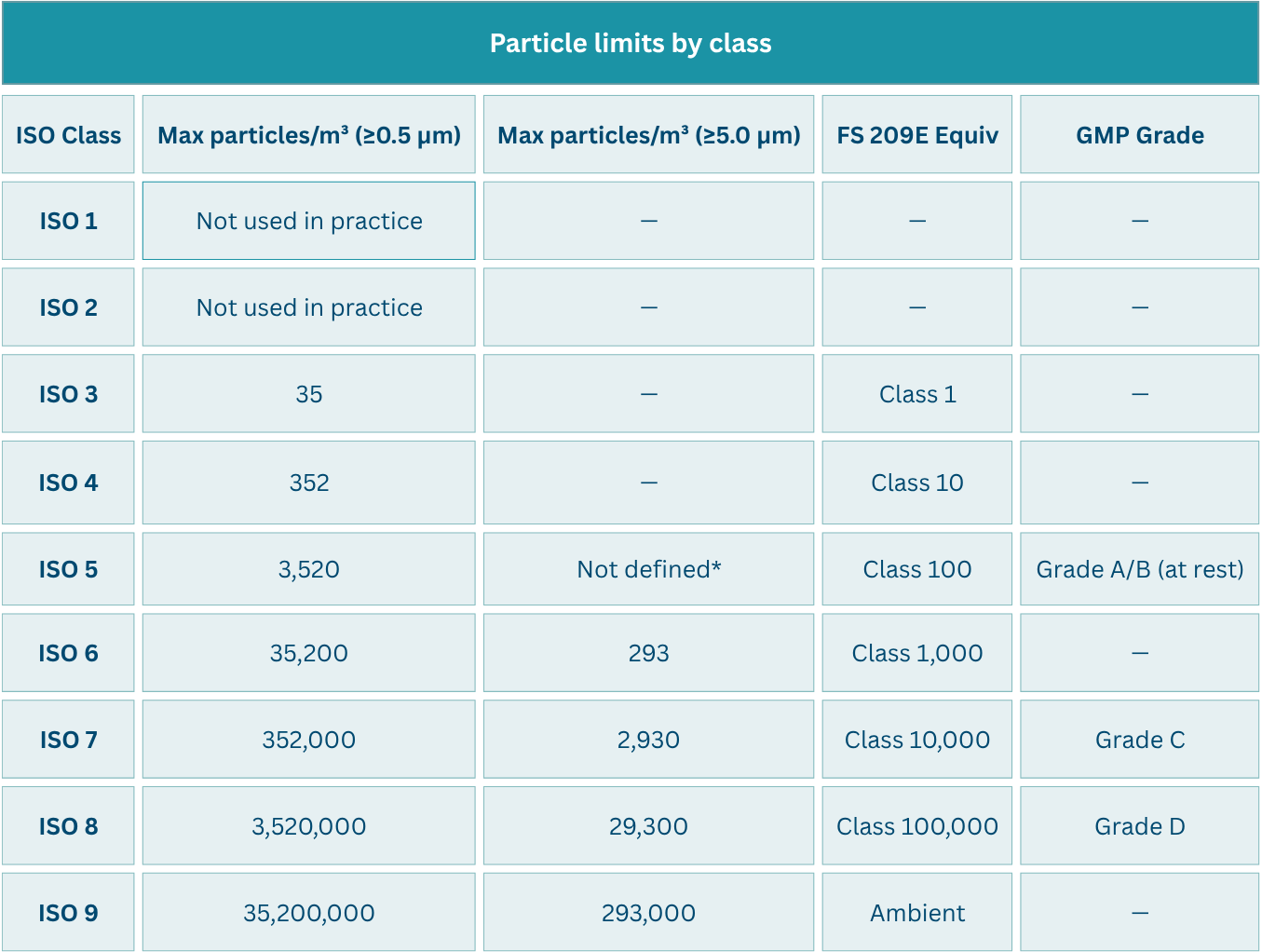
*ISO 14644 1:2015 removed the ≥5.0 µm requirement from ISO 5 classification. Pharmaceutical Grade A/B macro particle specifications are addressed separately using the M descriptor or GMP specific guidance.
Understanding each ISO class
ISO 1 & ISO 2
These represent theoretical cleanroom conditions that are rarely, if ever, achieved or required in commercial practice. No standard particle counter can reliably measure at these concentrations. These classes exist in the standard for completeness and for potential future nanotechnology research applications.
ISO 3 & ISO 4
Extreme ultraviolet (EUV) semiconductor lithography and advanced wafer fabrication represent the primary users of ISO 3 and ISO 4 environments. ISO 3 permits only 35 particles/m³ at ≥0.5 µm. Achieving these classes requires full ceiling laminar flow coverage, ULPA filtration, and extremely high air change rates (400 to 600 ACH). Construction and operational costs are very high.
ISO 5
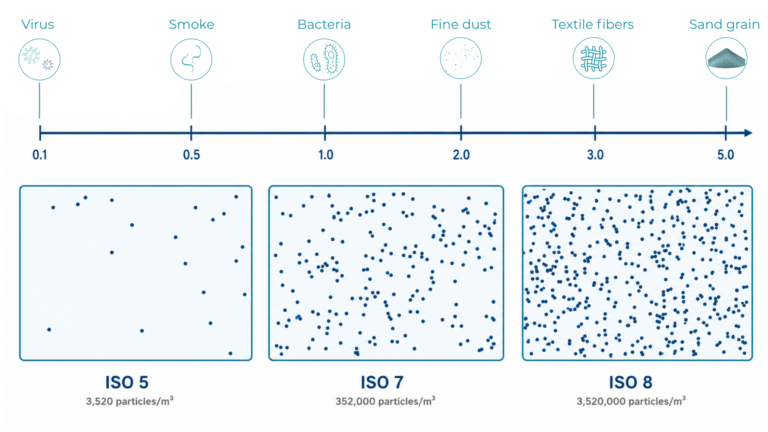
ISO 5 corresponds to FS Class 100 and GMP Grade A/B at rest and is one of the most common classifications in regulated industries. Maximum 3,520 particles/m³ at ≥0.5 µm.
Aseptic processing operations (filling lines, isolators, laminar flow hoods) operate at ISO 5. In pharmaceutical manufacturing, ISO 5 is the minimum for any zone where a product is exposed to the environment without further sterilization. ISO 5 requires H14 HEPA filtration, unidirectional (laminar) airflow, and 240 to 480 air changes per hour depending on room design.
ISO 6
Maximum 35,200 particles/m³ at ≥0.5 µm. Corresponds to FS Class 1,000. ISO 6 is used in semiconductor manufacturing support areas, high precision optical assembly, and some medical device production. It is less commonly the primary classification but often serves as a background environment around ISO 5 critical zones.
ISO 7
Maximum 352,000 particles/m³ at ≥0.5 µm. Corresponds to FS Class 10,000 and GMP Grade C. ISO 7 is one of the most widely used classifications in pharmaceutical and medical device manufacturing.
Non sterile pharmaceutical production, compounding, biotechnology operations, and medical device assembly typically operate at ISO 7. It is also frequently used as the background environment surrounding ISO 5 fill zones in aseptic manufacturing suites.
ISO 8
Maximum 3,520,000 particles/m³ at ≥0.5 µm. Corresponds to FS Class 100,000 and GMP Grade D. ISO 8 is the entry level for classified cleanroom environments. Electronics assembly, packaging, and less critical pharmaceutical support areas operate at ISO 8. Gowning areas in higher grade pharmaceutical facilities are typically ISO 8.
ISO 9
Maximum 35,200,000 particles/m³ at ≥0.5 µm. This approximates normal indoor air quality. ISO 9 is rarely specified as a formal cleanroom classification. It exists in the standard for reference. Some controlled but non classified (CNC) support areas may informally reference ISO 9 conditions.
"At rest" vs "In operation" classification
ISO 14644 part 1 requires that cleanrooms be classified under defined occupancy states.
At rest means the cleanroom is complete, fully operational with equipment installed and running, but without personnel present. This is the baseline condition and typically produces the lowest particle counts.
In operation means the cleanroom is running with the full number of personnel and with all processes active. Particle counts are higher due to human activity. People are the primary particle source in most cleanrooms.
For ISO classification purposes, the standard requires agreement between the customer and the supplier on which occupancy state applies. In pharmaceutical GMP environments, both states are typically tested and documented, with operating limits specified for each.
ISO classification vs GMP grade: understanding the relationship
The ISO classification system and the EU GMP grading system (Grade A through D) address overlapping but distinct requirements.
ISO 14644 part 1 defines air cleanliness by particle concentration only. It does not address microbiological contamination, pressure differentials, personnel flow, or process controls.
EU GMP Annex 1 adds microbiological limits, contamination control strategy requirements, and operational controls on top of ISO particle limits. GMP compliance requires both the ISO particle performance and the additional GMP specific operational requirements.
The approximate correlations are:
- Grade A (ISO 5): Critical aseptic operations: filling, stoppering, capping under laminar flow
- Grade B (ISO 5 at rest, ISO 7 in operation): Background environment for Grade A
- Grade C (ISO 7): Less critical steps in sterile manufacture
- Grade D (ISO 8): Non critical steps, initial gowning, materials preparation
For non pharmaceutical applications, ISO classification alone is the applicable standard.
How ISO class affects cleanroom design
The target ISO class drives the fundamental configuration decisions in a cleanroom:
HVAC and air change rates
Higher classifications require more air changes per hour to maintain particle concentrations within limits. This difference has a direct and significant impact on energy consumption and operating cost.
Filtration
HEPA H14 filtration (99.995% efficient at the most penetrating particle size) is the standard across ISO 5 through ISO 8 environments. ISO 3 and ISO 4 require ULPA filters (U15 or above, 99.9995% efficient).
Airflow pattern
ISO 5 and stricter classes require unidirectional (laminar) airflow: parallel air streams that sweep particles out of the critical zone. ISO 6 through ISO 9 typically use turbulent (mixed) airflow, which dilutes contamination through air volume exchange.
Pressure differentials
Cleanrooms maintain positive pressure relative to adjacent areas to prevent particle ingress when doors are opened. A minimum of 10 to 15 Pa differential between adjacent classes is standard. In pharmaceutical suites, pressure cascades from Grade A through D are a design requirement.
Surface materials and construction
Stricter classifications demand smoother, non-particle generating surfaces with coved joints, sealed penetrations and minimal horizontal ledges. Every design element that can accumulate particles or is difficult to clean becomes a contamination risk that grows more significant as the target class tightens.
How ISO classification is verified
Classification is not self declared. ISO 14644 part 1 requires formal measurement using light scattering airborne particle counters (LSAPC) at defined sampling locations, with a minimum number of locations calculated based on room area.
The process follows qualification stages:
- Design Qualification (DQ): Verifies that the cleanroom design will meet the target ISO class based on engineering calculations and specifications.
- Installation Qualification (IQ): Confirms that HVAC systems, filters and construction are installed according to design specifications.
- Operational Qualification (OQ): Verifies that the cleanroom achieves its ISO classification at rest, with all systems running.
- Performance Qualification (PQ): Demonstrates that the environment meets its specification under operational conditions with personnel and processes active.
After initial classification, ISO 14644 part 2 requires ongoing monitoring and periodic requalification: at least every 12 months for most cleanrooms, with the frequency driven by risk assessment and regulatory requirements.
Selecting the right ISO class
Selecting a classification that is stricter than necessary is not a minor issue. It directly increases construction cost, energy consumption, maintenance requirements and operational complexity, often without any benefit to product quality or patient safety.
The correct approach is to define the classification based on the contamination sensitivity of the process, not on a preference for a “safe” higher grade. Key questions include:
What particle sizes can cause a defect, failure, or contamination event in your product? What is the maximum acceptable particle concentration during exposure? What regulatory framework applies: GMP Annex 1, ISO 13485, FDA guidance? What are the cleanroom’s intended occupancy conditions?
A cleanroom that is overspecified is also harder to maintain in compliance, because the tighter the limits, the more sensitive the environment is to any deviation in cleaning, gowning, behavior, or equipment performance.

ABN's approach to classification
ISO 14644 part 1 defines nine cleanroom classes based on maximum allowable airborne particle concentrations per cubic meter. ISO 1 is the cleanest; ISO 9 is the least stringent. In practice, ISO 5 through ISO 8 cover the vast majority of industrial, pharmaceutical and medical device cleanroom applications.
Classification is determined by formal measurement at defined sampling locations, under agreed occupancy states, and must be requalified periodically. The ISO class drives every major engineering decision: filtration grade, airflow pattern, air change rate, pressure management and surface specification.
Selecting the correct classification requires understanding your process contamination risks and the applicable regulatory framework. Overspecifying wastes cost and increases compliance burden. Underspecifying puts product quality and regulatory status at risk.
Frequently asked questions
What is the most common ISO class for pharmaceutical cleanrooms?
ISO 5 (GMP Grade A/B) for aseptic processing, ISO 7 (Grade C) for supporting pharmaceutical operations, and ISO 8 (Grade D) for less critical areas and initial gowning. Most pharmaceutical facilities use multiple ISO classes within a single building.
Is ISO 14644 the same as GMP?
No. ISO 14644 1 defines air cleanliness by particle concentration only. EU GMP Annex 1 adds microbiological limits, contamination control strategy requirements, and operational controls. GMP compliance requires meeting ISO particle limits plus all additional GMP requirements.
How often does a cleanroom need to be reclassified?
ISO 14644 part 2 requires periodic requalification. For most cleanrooms, this means at least every 12 months, though pharmaceutical GMP environments may require more frequent testing based on risk assessment and regulatory expectations.
What is the difference between ISO 5 and ISO 7?
ISO 5 allows a maximum of 3,520 particles/m³ at ≥0.5 µm; ISO 7 allows 352,000: exactly 100 times more. ISO 5 requires laminar airflow and H14 HEPA filtration; ISO 7 typically uses turbulent airflow with H13 or H14 filtration. The construction and operating cost difference is significant.
Can a cleanroom operate at a stricter class than it is certified for?
A cleanroom performs to the conditions measured during classification testing. If a room is classified at ISO 7 but consistently measures at ISO 6 particle levels, it is not reclassified automatically: a formal reclassification exercise is required. Operating at a tighter level than certified provides no regulatory credit unless the classification is formally updated.