



HEPA filters in cleanrooms: How they work, types and selection guide
HEPA filters are the foundation of cleanroom air filtration systems. These high efficiency particulate air filters remove 99.97% of particles 0.3 micrometers and larger from the air stream, making them essential for maintaining the controlled environments required by pharmaceutical manufacturing, electronics production, and other contamination sensitive processes.
Understanding how HEPA filters work, their classification systems, and proper selection criteria ensures optimal cleanroom performance while controlling operational costs. The choice of filtration technology directly impacts both contamination control effectiveness and energy consumption throughout the facility lifecycle.
What are HEPA filters and how do they work
HEPA filters capture particles through three physical mechanisms: impaction, interception, and diffusion. Contrary to common belief, HEPA filters do not work like sieves that simply block particles larger than their pore size.
Impaction occurs when larger particles follow air streamlines and collide directly with filter fibers. Interception happens when particles follow streamlines that pass close enough to fibers for the particles to be captured. Diffusion affects the smallest particles, which exhibit Brownian motion and randomly collide with fibers as they move through the filter media.
The 0.3 micrometer particle size used in HEPA efficiency ratings represents the most penetrating particle size (MPPS). This is the particle size most likely to pass through the filter because it is too small for efficient impaction and interception, yet too large for significant diffusion. Particles both smaller and larger than 0.3 micrometers are actually captured more efficiently.
HEPA filter media is typically made from borosilicate glass microfibers arranged in a pleated configuration to maximize surface area within the filter frame. The pleating increases the effective filtration area, reducing face velocity and pressure drop while maintaining high efficiency.
HEPA filter classifications and standards
HEPA filters are classified according to their minimum efficiency at the most penetrating particle size. The classification systems vary by region but serve the same fundamental purpose of ensuring consistent performance.
- European standard EN 1822 defines filter classes from E10 through U17. HEPA filters range from H10 (minimum 85% efficiency) through H14 (minimum 99.995% efficiency). ULPA (Ultra Low Penetration Air) filters include classes U15 through U17, with U15 achieving minimum 99.9995% efficiency.
- US standard ASHRAE 52.2 uses minimum efficiency reporting value (MERV) ratings, though true HEPA filters are typically tested according to military standard MIL STD 282 or Institute of Environmental Sciences and Technology (IEST) procedures.
- ISO 29463 provides an international standard that aligns closely with European classifications while establishing global consistency for filter performance testing.
For cleanroom applications, H13 and H14 filters are most commonly specified. H13 filters provide 99.95% minimum efficiency, while H14 filters achieve 99.995% minimum efficiency. The choice between these grades depends on the cleanroom classification and contamination control requirements.
Laminar flow vs turbulent flow systems
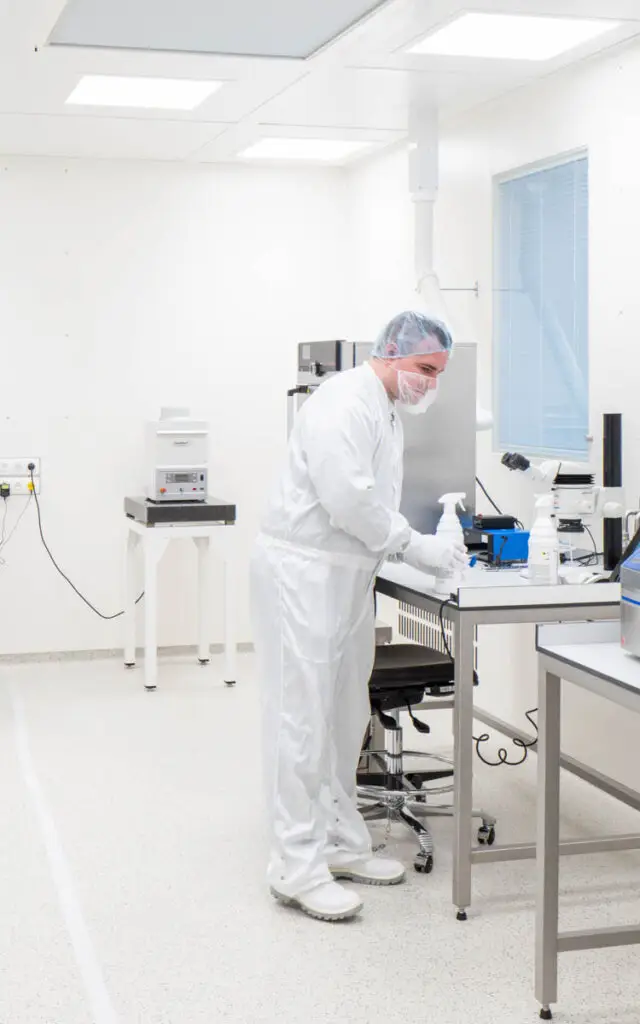
Laminar flow systems create uniform, parallel air streams that sweep particles downward and out of the cleanroom. These systems typically use full ceiling coverage with HEPA filters, creating a clean air blanket over the entire work area. Laminar flow is required for ISO Class 5 cleanrooms and is often used in critical areas of higher class cleanrooms.
Turbulent flow systems use supply air diffusers and return air grilles to create mixed airflow patterns that dilute airborne contamination. These systems are more energy efficient than laminar flow systems and are suitable for ISO Class 6 through 8 cleanrooms where product exposure time is limited.
The filter arrangement differs between these systems. Laminar flow systems require filters mounted in the ceiling with minimal bypass leakage, while turbulent flow systems may use central air handling units with HEPA filters located in the equipment room or terminal HEPA filters at supply diffusers.
HEPA filter selection for different ISO classes
HEPA filter selection must match the cleanroom classification and the processes performed within the space. Higher classification cleanrooms require more stringent filtration and often multiple stages of filtration.
- ISO Class 5 cleanrooms typically require H14 HEPA filters with laminar flow systems. The high efficiency rating ensures particle concentrations remain below the stringent limits, while laminar flow provides the unidirectional airflow necessary for this classification.
- ISO Class 6 and 7 cleanrooms commonly use H13 or H14 HEPA filters depending on the specific processes and contamination risks. These cleanrooms may use either laminar or turbulent flow systems, with filter selection influenced by the air distribution method.
- ISO Class 8 cleanrooms often use H13 HEPA filters with turbulent flow systems. The less stringent particle limits allow for more energy efficient air distribution while maintaining appropriate contamination control.
The number of air changes per hour also influences filter selection. Higher air change rates can compensate for slightly lower filter efficiency, but this trade off must be evaluated against energy costs and noise levels.
ULPA filters for critical applications
Ultra Low Penetration Air (ULPA) filters provide even higher efficiency than HEPA filters, removing 99.999% or more of particles 0.12 micrometers and larger. These filters are used in the most critical cleanroom applications where conventional HEPA filtration is insufficient.
Semiconductor manufacturing often requires ULPA filters, particularly for advanced node production where even minimal particulate contamination can cause device failures. The smaller feature sizes demand correspondingly smaller particle control.
Pharmaceutical isolator systems may use ULPA filters to maintain the highest levels of sterility during aseptic processing. The enhanced filtration provides additional assurance against microbial contamination.
Research applications working with hazardous materials sometimes require ULPA filtration to protect both the product and personnel from contamination risks.
The primary disadvantages of ULPA filters are higher initial cost, increased pressure drop and reduced service life compared to HEPA filters. These factors must be balanced against the improved contamination control for each specific application.
Installation and sealing requirements
Proper HEPA filter installation is critical for maintaining cleanroom performance. Any bypass leakage around the filter frame or through damaged media compromises the entire filtration system.
- Filter frames must be precisely manufactured to prevent distortion during installation. Gel sealed filters use polyurethane gel between the filter housing and frame to eliminate bypass leakage. Knife edge seals create compression seals when the filter is clamped into place.
- Installation procedures require careful handling to prevent filter media damage during transport and installation. Filters should be visually inspected before installation and tested after installation to verify performance.
- Leak testing using dioctyl phthalate (DOP) or other approved aerosols confirms that the installed filter system achieves the specified efficiency. Testing should include both filter media and the entire filter installation including frames and sealing systems.
- Mounting systems must support the filter weight and provide adequate sealing without creating stress points that could cause frame distortion. The mounting system should allow for thermal expansion while maintaining seal integrity.
Maintenance and replacement schedules
HEPA filter service life depends on the particulate loading, operating conditions, and contamination control requirements. Modern maintenance approaches balance contamination control with operational efficiency through data driven scheduling.
Pressure drop monitoring provides the most reliable indicator of filter loading. As particles accumulate on the filter media, pressure drop increases. Most HEPA filters should be replaced when pressure drop reaches twice the initial clean pressure drop.
Condition based and predictive maintenance are enabled by Smartlog (ABN’s environmental monitoring platform), which uses real time monitoring data to determine optimal replacement timing and forecast future filter performance. Smartlog integrates pressure drop measurements, particle counts, and environmental conditions through structured dashboards and trend analysis capabilities. Instead of fixed schedules, filters are replaced when monitoring data indicates replacement is necessary or trends predict upcoming failures, supporting comprehensive filter performance tracking and planned maintenance scheduling.
Particle counting in the cleanroom can indicate filter degradation before pressure drop limits are reached. Increasing particle concentrations may signal filter bypass leakage or media degradation.
Visual inspection during routine maintenance can identify obvious damage or contamination that would require immediate filter replacement regardless of monitoring data.
Pre-filters upstream of HEPA filters extend HEPA filter life by removing larger particles before they reach the HEPA media. Proper pre filtration is essential for economical operation.
Energy efficiency considerations
HEPA filtration represents a significant portion of cleanroom energy consumption. Filter selection and system design must balance contamination control requirements with energy efficiency.
Pressure drop
Pressure drop directly affects fan energy consumption. Lower pressure drop filters reduce operating costs but may compromise filtration efficiency or service life. The total cost of ownership should include both initial filter cost and operating energy costs.
Filter media
Filter media area affects both efficiency and pressure drop. Deeper pleated filters provide more media area in the same face dimensions, reducing face velocity and pressure drop while maintaining high efficiency.
Air Change Rate
Air change rates should be optimized for each cleanroom classification and process requirement. Excessive air changes waste energy without providing additional contamination control benefits.
ABN's approach to filtration systems
ABN Cleanroom Technology’s Configure-to-Order Plus approach combines standardized modular building blocks into precisely tailored solutions. This systematic methodology considers contamination control requirements, including filtration systems, from the initial design stages rather than adding them afterward.
Filter maintainability is integrated into this design process from the start. ABN designs cleanrooms so filters can be accessed and replaced without shutting down the cleanroom, using standard filter types that work predictably. Training courses and procedures ensure only qualified personnel handle HEPA filters.
The ADAPTUS Product Platform powers this fully data driven process from design through delivery, supporting consistent cleanroom performance throughout the facility lifecycle. ABN’s full lifecycle services include design, build, maintenance, validation, and operational support for cleanroom facilities across Europe.
Final thoughts
HEPA filters are essential components of cleanroom environmental control systems, but their effectiveness depends on proper selection, installation, and maintenance. Understanding filter classifications, airflow patterns, and application requirements ensures optimal contamination control performance.
The choice between HEPA and ULPA filters, laminar and turbulent flow systems, and various efficiency grades should be based on cleanroom classification requirements, process contamination sensitivity, and total cost of ownership considerations.
Successful cleanroom filtration requires integrating filter performance with air handling system design, installation procedures, and maintenance programs. When properly implemented, HEPA filtration systems provide reliable contamination control throughout the facility operating life.