



GMP cleanroom requirements for pharmaceutical industry
GMP cleanrooms in the pharmaceutical industry are controlled environments designed to minimize the risk of contamination during manufacturing processes. Their requirements are defined primarily in EU GMP Annex 1 and supported by ISO 14644 standards for airborne particle classification.
Cleanroom compliance is based on maintaining defined environmental conditions both “at rest” and “in operation”, ensuring consistent product quality and patient safety.
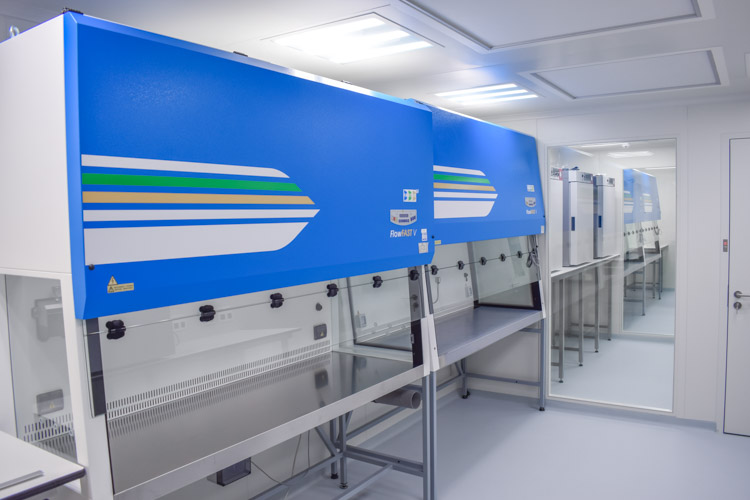
GMP vs ISO 14644
ISO 14644-1 classifies cleanrooms based on the concentration of airborne particles per cubic meter of air.
EU GMP Annex 1 builds on this by introducing requirements for:
- Microbiological (viable) contamination
- Environmental monitoring
- Process protection
- Contamination control strategy (CCS)
ISO classification alone is not sufficient for pharmaceutical applications; GMP compliance requires control of both non-viable and viable contamination.
GMP cleanroom classification
EU GMP Annex 1 defines four cleanroom grades:
- Grade A (ISO 5): critical aseptic operations
- Grade B: background environment for Grade A
- Grade C: less critical steps
- Grade D: initial stages
Limits apply to both “at rest” and “in operation” conditions, with stricter requirements during operation.
Environmental and airflow requirements
GMP requires controlled airflow patterns and pressure differentials to prevent contamination.
- Grade A zones use unidirectional airflow
- Grades B–D typically use mixed airflow systems
- Pressure differentials (typically ≥10 Pa) ensure airflow from cleaner to less clean areas
Air handling systems must include HEPA filtration and provide sufficient air changes to maintain classification under operational conditions.
Contamination Control Strategy (CCS)
EU GMP Annex 1 requires the implementation of a documented Contamination Control Strategy (CCS) that addresses all potential sources of contamination. This strategy encompasses key elements such as facility and HVAC design, personnel and material flows, cleaning and disinfection procedures, and environmental monitoring. By integrating these aspects, the CCS provides a structured, lifecycle-based approach to effectively manage and control contamination risks.
Validation and monitoring
Qualification stages
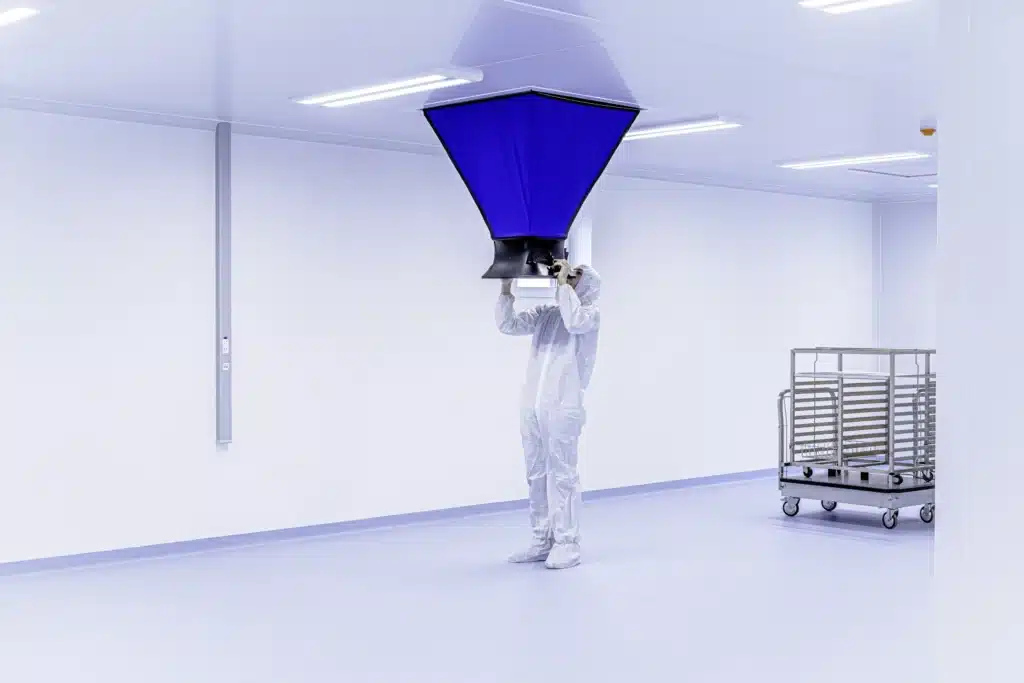
Cleanrooms must be qualified and continuously monitored to demonstrate compliance.
- DQ (Design Qualification) - Verifies that the cleanroom design meets GMP and user requirements.
- IQ (Installation Qualification) - Confirms that systems (HVAC, panels, filters, equipment) are installed according to specifications.
- OQ (Operational Qualification) - Verifies that systems operate within defined limits (airflow, pressure, temperature, alarms).
- PQ (Performance Qualification) - Demonstrates that the cleanroom performs as intended under real operational conditions.
Monitoring & data integrity
Ongoing monitoring includes:
- Airborne particle counting
- Microbiological monitoring
- Pressure and airflow verification
For GMP environments, data integrity is critical. Systems used for monitoring and data management must comply with 21 CFR Part 11, ensuring:
- Secure data storage
- Audit trails
- Electronic record integrity
ABN Cleanroom Technology’s GMP Connect platform is designed in accordance with these requirements, enabling compliant monitoring and data handling within regulated environments.
Process flow and cleanroom operation
GMP cleanrooms must be designed around controlled processes and personnel flows.
Personnel and materials typically move progressively from: Grade D -> Grade C -> Grade B -> Grade A
To maintain this flow:
- Personnel Airlocks (PAL) and Material Airlocks (MAL) are required
- In higher-risk environments, double PAL/MAL configurations are implemented
- Gowning procedures follow stepwise transitions aligned with cleanroom grades
These controlled pathways are essential to prevent cross-contamination and maintain environmental integrity.
Typical applications
- Aseptic processing and sterile manufacturing
- Pharmaceutical compounding and preparation
- Biotechnology production
For hospital environments, ABN Cleanroom Technology has developed the SteriCube HOSPIX solution: a mobile modular cleanroom concept specifically designed for pharmaceutical departments preparing cytostatic medicines, ensuring compliance with GMP requirements while enabling efficient integration within hospital infrastructure.
Design consideration
Design for compliance
EU GMP Annex 1 requires that cleanrooms are designed to minimize contamination risks and support validation and monitoring. At ABN Cleanroom Technology, cleanrooms are configured using pre-engineered and validated building blocks within a Configure-to-Order Plus (CTO+) methodology.
This approach ensures that:
- Compliance is embedded in the design phase
- Critical parameters are predefined and validated
- Cleanrooms meet regulatory requirements from the outset
Design for operational reality
Cleanroom performance must be maintained under real conditions. Personnel movement, equipment layout and material flow directly influence contamination behaviour.
Improper airflow distribution, poor zoning or inadequate return placement can lead to localized contamination risks, even when classification limits are met.
Final thoughts
GMP cleanroom requirements combine ISO-based air cleanliness with regulatory expectations for process control, monitoring and data integrity.
Compliance depends on a cleanroom’s ability to perform consistently under operational conditions, supported by validated design, controlled process flows and continuous monitoring. A design approach that integrates compliance from the outset ensures predictable performance and long-term regulatory alignment.