



Cleanroom solutions for aerospace manufacturing and defense
Cleanrooms configured without compromise
ABN Cleanroom Technology designs and delivers high-performance cleanroom environments for regulated and mission-critical industries. At the core of our approach is ADAPTUS, a structured library of pre-engineered and validated building blocks. Each building block is engineered above a defined Olympic Minimum performance level for reliability, sustainability, speed, and budget control. Because these modules are developed, tested, and validated at platform level, their interfaces, behavior, and performance characteristics are fully predictable before a project begins.
This platform foundation enables our Configure-to-Order Plus (CtO+) framework. CtO+ begins by defining which value is most critical for the client’s project (speed, reliability, sustainability, or budget control), while the remaining values are protected by the Olympic Minimum embedded within ADAPTUS. Configuration therefore occurs within controlled boundaries. Trade-offs below Olympic Minimum performance are not negotiated or mitigated; they are structurally prevented.
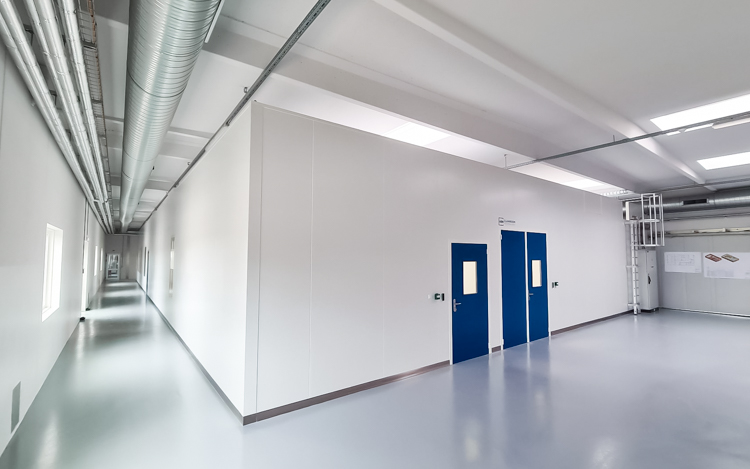
Configuration for aerospace and defense: speed and cost efficiency as priorities
ICONIC: CtO+ for aerospace manufacturing and defense
In aerospace and defense projects, rapid deployment and controlled upfront investment frequently determine program feasibility. Facility timelines must align with program milestones, and infrastructure investment must remain predictable within complex funding structures.
For aerospace clients prioritizing speed and cost efficiency, we configure our ICONIC cleanroom solution. ICONIC is optimized for rapid deployment and controlled CAPEX, leveraging our ADAPTUS platform to reduce engineering time, minimize redesign cycles, and streamline commissioning and qualification.
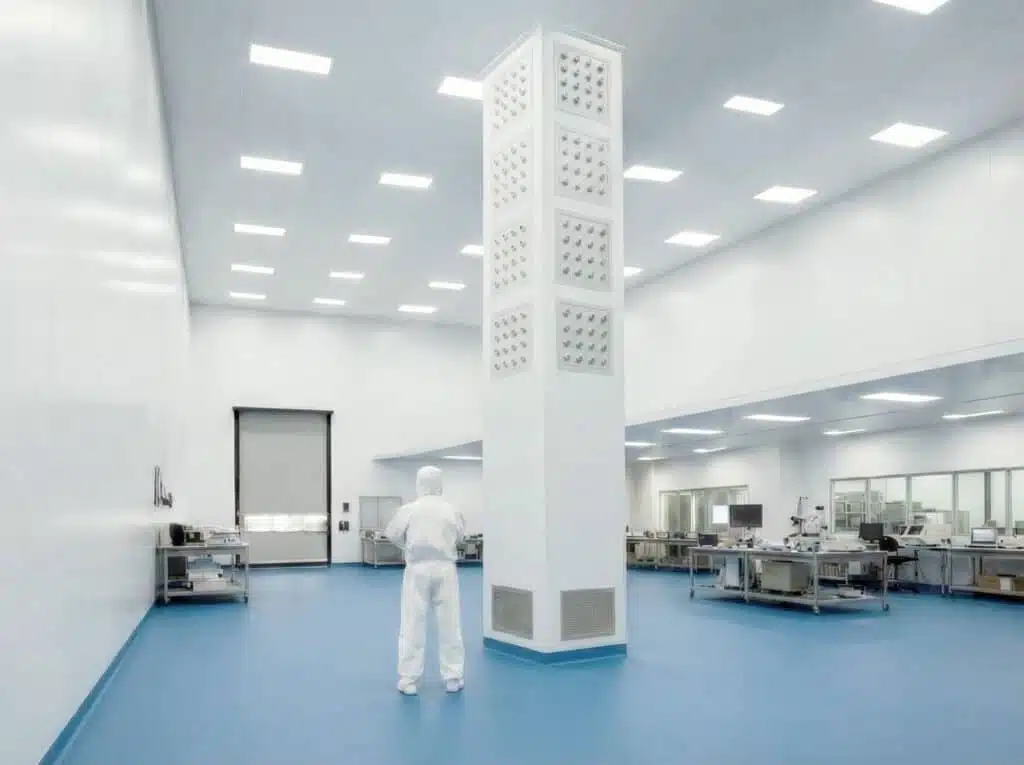
AIKON for controlled airflow behavior at height
When cleanrooms involve significant ceiling height, we integrate our AIKON building block. High vertical volumes introduce challenges such as air stratification and reduced airflow efficiency. AIKON is engineered specifically to manage these vertical dynamics, with controlled HEPA filtrated air recirculation to maintain environmental stability throughout the full height of the space. This enables aerospace and defense manufacturers to achieve:
- Controlled airflow behavior at height
- Reduced stratification effects
- Energy-efficient recirculation
- Predictable validation results
Speed and cost efficiency are achieved through smart cleanroom design decisions, not through reduced technical performance.
Key applications of CtO+ cleanrooms in aerospace manufacturing and defense
Cleanrooms play a critical role across multiple aerospace manufacturing stages, where contamination control directly impacts system reliability and mission success.
- Satellite Assembly
Satellite integration and testing require tightly controlled environments to protect sensitive electronics, optical payloads, and sensor systems. Even microscopic contamination can affect performance or long-term reliability in orbit. - Aircraft Component Manufacturing
Precision components such as avionics assemblies, turbine elements, and control systems are manufactured in controlled environments to ensure dimensional accuracy, material integrity, and operational efficiency. - Space Exploration Systems
The assembly of spacecraft, landers, and exploration vehicles demands stable environmental conditions to protect mission-critical systems that must operate flawlessly in extreme environments.
In each of these applications, environmental control is not optional, it is fundamental to performance and risk mitigation.

Aerospace-specific environmental requirements
Aerospace cleanrooms typically operate between ISO Class 5 and ISO Class 8 under ISO 14644-1. However, ISO classification alone is not sufficient. Aerospace and defense environments require multiple paramaters that must be achieved not only during initial validation, but consistently over the lifecycle of the facility.
Structural & flooring considerations
- ESD-dissipative flooring for electronics
- High load-bearing capacity for heavy assemblies
- Compatibility with overhead handling systems
- Low particle-generating surface finishes
Airflow & pressure control
- Defined pressure cascades between integration zones
- Unidirectional airflow in critical areas
- Controlled recovery times
- Air change effectiveness aligned with process sensitivity
Environmental stability
- Tight temperature tolerances
- Controlled humidity
- Stable vertical air columns in high spaces
Material & molecular awareness
- Low-outgassing construction materials
- Surface compatibility control
- Mitigation of molecular contamination risk
Future-ready infrastructure and controlled upgrades
Aerospace programs evolve. Capacity may increase, layouts may change, and environmental demands can become more stringent over time. To support this, our cleanroom architecture is designed for scalability. Heat Recovery Units (HRU) enable efficient capacity increases without redesigning the HVAC backbone. For future modifications or expansions, our modular ADAPTUS platform allows upgrades to be executed in a controlled and predictable manner, minimizing disruption to ongoing operations. This ensures that cleanroom infrastructure is not only optimized for today’s requirements, but prepared for future growth.
Commissioning, validation and lifecycle assurance
Environmental performance in aerospace manufacturing must be verifiable and repeatable. Our structured, risk-based approach includes:
- Installation and operational verification
- ISO 14644 cleanroom validation
- Airflow visualization and velocity measurement
- Particle counting (LSAPC)
- HEPA/ULPA filter integrity testing
- Recovery and air change effectiveness testing
Because our cleanrooms are configured from validated building blocks, qualification confirms performance instead of discovering variability. Continuous monitoring ensures long-term stability, environmental traceability, and operational assurance throughout the program lifecycle.
Let’s build predictability into your aerospace and defense environment
Aerospace cleanroom infrastructure must deliver certainty, not introduce risk. If your program requires controlled cost, defined performance, accelerated deployment, or long-term environmental stability, these priorities must be built into the system architecture from the start, not optimized later in the project.
ABN Cleanroom Technology configures aerospace cleanrooms within governed performance boundaries, ensuring that critical values remain protected while your program priorities lead the configuration. If you are evaluating a new facility, upgrading an existing environment, or aligning infrastructure with upcoming program milestones, we welcome a structured technical discussion to explore how your requirements can be translated into a predictable configuration model.
Let’s define your priorities, and build from a foundation where performance is already protected.
FAQ
The most frequently asked questions about our Configure-to-Order+ approach for the aerospace and defense industry
What is Configure-to-Order Plus (CtO+)?
Configure-to-Order Plus (CtO+) is ABN Cleanroom Technology’s system-based approach to cleanroom delivery. It allows cleanrooms to be configured around project priorities while guaranteeing minimum performance levels for speed, reliability, sustainability, and budget control by design.
What is the Olympic Minimum?
The Olympic Minimum is a non-negotiable baseline that defines minimum performance levels for speed, reliability, sustainability, and budget control. Every ABN cleanroom meets this baseline regardless of configuration choices.
What is the ADAPTUS platform?
ADAPTUS is ABN’s cleanroom product platform made of pre-engineered and validated building blocks. It embeds performance, validation, and value protection directly into the system architecture.
How do you control cost without reducing performance?
Within the CtO+ framework, budget control can be prioritized while protecting minimum performance levels for reliability, sustainability, and delivery speed.
What ISO class is typically required for aerospace cleanrooms?
Most aerospace applications operate between ISO Class 5 and ISO Class 8, depending on process sensitivity. Critical integration areas such as satellite or optical assembly often require higher cleanliness levels.
How do you manage high-ceiling cleanrooms?
High-ceiling environments can create airflow and temperature stability challenges. When required, AIKON can be integrated to maintain uniform air circulation across the full height of the space.
Can the cleanroom be expanded or upgraded later?
Yes. Our platform-based architecture allows controlled upgrades and capacity increases without redesigning the entire system. Solutions such as HRU support scalable airflow and energy efficiency.