



Cleanrooms for medical devices: requirements, classifications and how to get it right
What medical device manufacturing actually requires
Medical device manufacturing demands more from a cleanroom than most other industries. Particle counts matter, but so does pressure cascading, material flows, personnel gowning, and regulatory documentation. A cleanroom that is right for one product type may be entirely wrong for another, even within the same company. This is why the process definition must come before the cleanroom specification.
This guide walks through the cleanroom requirements specific to medical devices, the sub-industries within the sector and how their needs differ, and what to look for when designing or procuring a cleanroom environment that truly fits your process.
Why medical device cleanrooms are different
Most industries use cleanrooms to protect the product from contamination. Medical devices must do that too, but the stakes are higher because the product enters, contacts, or interacts with the human body. That introduces two additional layers of obligation:
Regulatory compliance: Medical devices sold in Europe must comply with EU MDR 2017/745 (and IVDR 2017/746 for diagnostics). The cleanroom itself is part of your quality management system and will be audited. You need documented qualification, monitoring data and change control procedures, not just a working installation.
Patient safety as the design driver: Every cleanroom decision, from air change rate to gowning room sequence to drain placement, has a traceability that leads back to the risk assessment for your device. That is a different mindset from, say, electronics or optics, where contamination control is about yield rather than patient harm.
Cleanroom classifications for medical devices
Medical device cleanrooms are classified under ISO 14644-1. The relevant classes for most device manufacturers are:
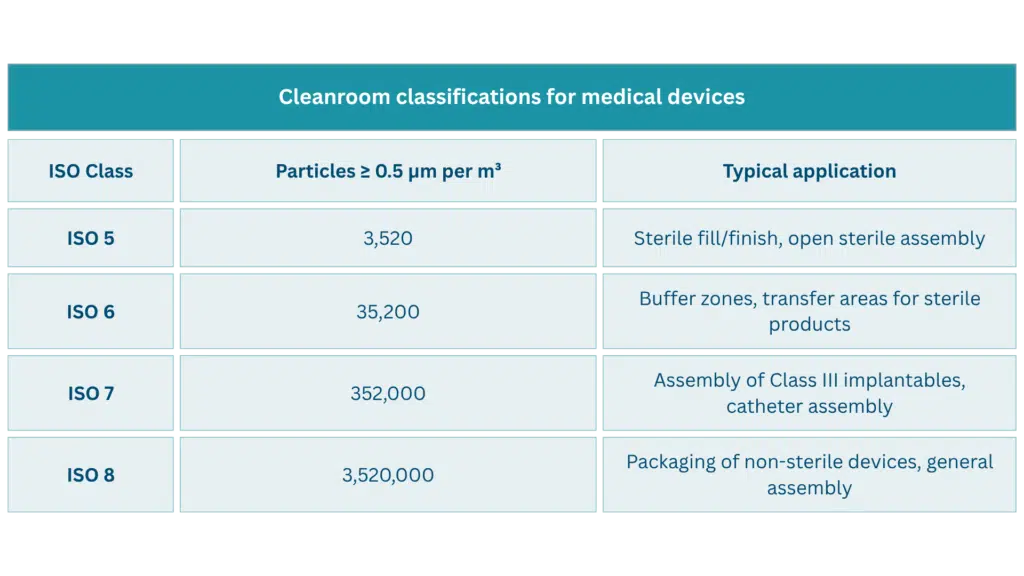
A common mistake is treating classification as the only specification. Two ISO 7 rooms can behave very differently depending on HVAC design, pressure differentials, gowning protocol, and cleaning regime. Classification is the floor, not the ceiling of your requirements.
Sub-industries and their specific requirements
Medical devices is a broad sector. The cleanroom requirements shift significantly depending on which segment you operate in.
Implantable devices (Class III under EU MDR)
This is the most demanding segment. Orthopaedic implants, cardiac devices, neurological stimulators, and similar products require assembly environments that minimise contamination to the lowest achievable level. ISO 7 is typically the minimum for final assembly, with ISO 5 laminar flow zones used for the most critical operations.
Pressure cascades must be documented and continuously monitored. Personnel flows and material flows need to be physically separated. Surface finishes on walls and floors must support validated cleaning protocols, with no ledges or joints that harbour contamination.
In Vitro Diagnostics (IVD)
IVD manufacturers produce test kits, reagents, and diagnostic instruments. The specific requirement depends on whether the manufacturing step involves open liquid handling of biological materials, which typically drives ISO 7, or closed assembly of instruments, which may only require ISO 8 with rigorous cleaning procedures.
IVD facilities often need to manage cross-contamination between different analytes as much as particulate cleanliness does. Zoning, directed airflow and room pressure relationships are critical design variables.
Wound care and single-use devices
Dressings, catheters, syringes and similar single-use products are typically manufactured in ISO 7 or ISO 8 environments, then sterilised downstream. The cleanroom here serves to minimise bioburden going into the sterilisation step, not to produce a sterile product directly.
These facilities tend to be high-throughput and require cleanrooms that accommodate production lines, good ergonomics, and easy cleaning between batches. Flexibility and maintainability are as important as the initial specification.
Combination products (Device + Drug)
Drug-device combinations such as pre-filled syringes, drug-eluting stents, and inhaler devices sit at the intersection of EU MDR and EU GMP (Annex 1:2022 for sterile products). These require cleanrooms that satisfy both frameworks simultaneously, which means the design must satisfy ISO classification, GMP grade and the associated monitoring and documentation requirements of both.
This is one of the most complex cleanroom briefs in the industry, and it is where a poorly specified or generic cleanroom creates the most risk.
Dental and Ophthalmic devices
Dental implants, orthodontic components, contact lenses and intraocular lenses each carry specific material and process requirements. Contact lens manufacturing, for example, requires tightly controlled humidity as well as particle cleanliness, because moisture affects the lens geometry during production. These nuances must be captured in the cleanroom specification before design begins.
This is one of the most complex cleanroom briefs in the industry, and it is where a poorly specified or generic cleanroom creates the most risk.
Key design parameters beyond classification
Classification tells you the maximum particle concentration. A properly designed cleanroom for medical devices requires several additional parameters to be deliberately specified:
Pressure differentials: Cleanrooms for medical devices typically operate at positive pressure relative to adjacent corridors, with a documented cascade. This prevents ingress of contamination when doors are opened. For facilities handling potent biologics or cytotoxic compounds, certain zones may require negative pressure to contain the material.
Air change rates: 60 ACH per hour is a frequently applied starting point for ISO 7 cleanrooms. But the right number for your facility depends on the heat load, the number of personnel, the process equipment and the room geometry. Underspecifying this is a common source of classification failures during requalification.
Material and personnel airlocks: Every entry point into the cleanroom is a contamination risk. The airlock design, including whether it is a cascaded pressure airlock or a bubble airlock, affects how much contamination enters during normal operation.
Surface materials: Walls, floors, and ceilings must be smooth, non-particle-shedding, chemical-resistant, and compatible with the cleaning and disinfection agents used in the facility. Medical device facilities often use sporicidal agents periodically, which places higher demands on surface durability than many other industries.
Utility penetrations: Every pipe, cable, and duct penetration is a contamination risk and a cleaning challenge. The number and placement of penetrations should be minimised and sealed to a validated standard.
The Configure-to-Order Plus difference
One of the consistent problems in medical device cleanroom procurement is over-specification for some parameters and under-specification for others. A generic cleanroom designed to “ISO 7” may have inadequate pressure cascading, poorly placed supply and extract grilles, insufficient electrical capacity for monitoring equipment, or wall finishes that cannot withstand daily sporicidal cleaning.
The Configure-to-Order+ approach that ABN Cleanroom Technology uses is built around a different starting point: understanding the exact process before selecting the building blocks. Rather than starting from a standard room and adjusting it, the conversation begins with what happens inside the cleanroom, who works there, what materials move through it, and what regulatory framework applies.
The result is a cleanroom specification that covers only what the process actually requires, and nothing that it does not. For medical device manufacturers, this matters because unnecessary complexity adds validation burden, maintenance overhead, and cost without adding any product quality or regulatory benefit.
Validation and ongoing compliance
before handover, and ongoing monitoring throughout its operational life.
Installation Qualification (IQ): Documented evidence that everything was installed as specified.
Operational Qualification (OQ): Evidence that the cleanroom performs as specified when operating under representative conditions.
Performance Qualification (PQ): Evidence of sustained performance over time, including particle counts, differential pressure, air change rates, and temperature and humidity.
Ongoing environmental monitoring: Continuous or periodic monitoring of particle counts, differential pressure, and microbiological contamination, with defined alert and action limits and a documented response procedure for excursions.
These requirements are not optional in a regulated environment. The cleanroom supplier should understand them and design for them from the outset, not as an afterthought.
The right cleanroom starts with CTO+
Cleanrooms for medical devices must be designed around the specific sub-industry, process, and regulatory framework, not around a generic ISO class. Implantables, IVDs, wound care, combination products, and dental or ophthalmic devices all have distinct requirements, and the right cleanroom for one is not necessarily the right cleanroom for another.
Getting the specification right at the start avoids costly requalification, reduces validation burden, and ensures that the cleanroom is a genuine enabler of regulatory compliance rather than a source of ongoing risk.
ABN Cleanroom Technology designs and builds cleanrooms for medical device manufacturers across Europe. ABN’s Configure-to-Order+ approach ensures that every installation is specified around your process requirements, your regulatory obligations, and your operational lifecycle, with no unnecessary complexity added.