



Cleanroom cleaning: Complete guide to procedures, standards & services
Cleanroom cleaning is fundamentally different from regular commercial cleaning. Whether it is the life sciences or high-tech, this type of cleaning requires specialized procedures, approved materials and trained personnel to maintain environmental conditions that protect product quality and ensure regulatory compliance. Unlike conventional cleaning that focuses on appearance, cleanroom cleaning controls both viable and non-viable particles while preserving critical environmental conditions.
Why cleanroom cleaning is different
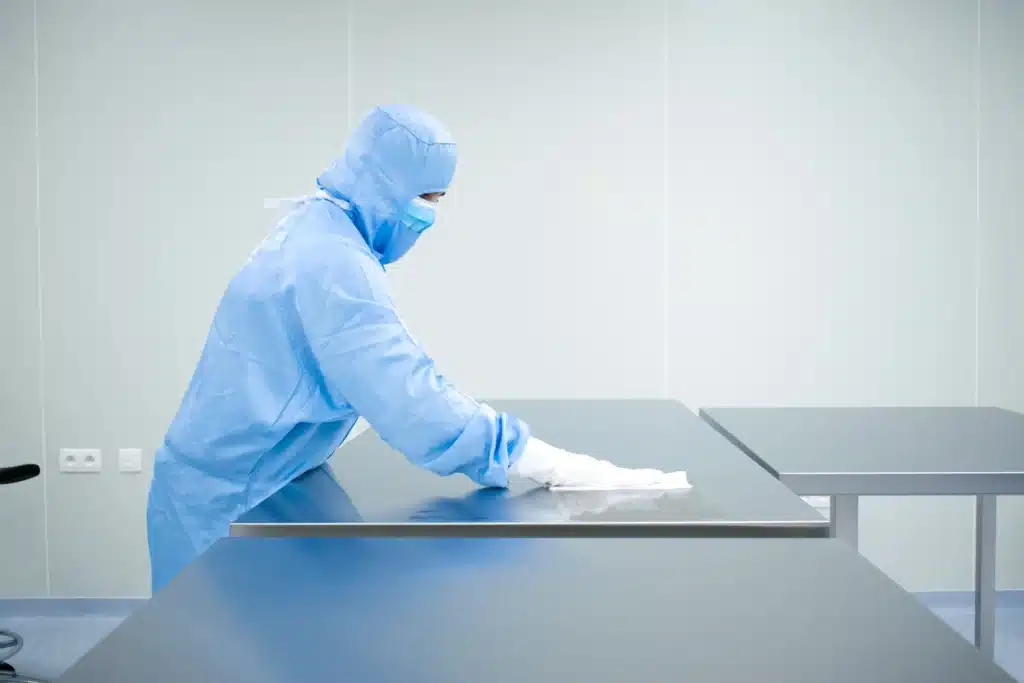
Cleanroom cleaning controls contamination rather than appearance. According to EU GMP Annex 1 and ISO 14644, cleaning procedures must remove particles and reduce bioburden without compromising the controlled environment. Standard cleaning products and methods are unsuitable because they can introduce contamination or disrupt critical environmental parameters like airflow patterns. This means that the cleaning sequence must follow the airflow pattern: always clean in the direction air travels toward the exhaust/return vents. Cleaning against the airflow would push contamination back into cleaner zones. Cleaning staff needs to be very aware to move with the airflow, not against it, to avoid walking through their own particle wake and recontaminating surfaces.
All cleanroom cleaning activities must be controlled, documented, and validated to demonstrate consistent contamination control effectiveness.
Regulatory standards that apply
Cleanroom cleaning requirements are defined by multiple regulatory frameworks:
- EU GMP Annex 1 specifies cleaning frequencies, approved materials and documentation requirements for pharmaceutical cleanrooms. Cleaning procedures must be part of a comprehensive Contamination Control Strategy.
- ISO 14644 standards address cleanroom operation and monitoring, including contamination control measures during cleaning activities.
- FDA guidance outlines cleaning requirements that support aseptic processing environments, with emphasis on validated procedures and qualified personnel.
All regulations share common principles: cleaning must be controlled, documented and validated to demonstrate consistent contamination control.
Approved materials and cleaning agents
- Isopropyl alcohol (IPA) at 70% concentration remains the most common cleanroom disinfectant, providing effective microbial reduction while evaporating cleanly.
- Hydrogen peroxide solutions offer broader antimicrobial activity and are increasingly used in higher grade cleanrooms, including vaporized hydrogen peroxide (VHP) systems for room wide decontamination.
- Sterile water for injection (WFI) or purified water is used for final rinses and solution preparation to avoid introducing contaminants.
- Cleanroom wipes made from polyester, polypropylene, or cellulose blends minimize particle generation and lint production.
- HEPA filtered vacuum systems remove particles without redistributing them into the environment. Standard vacuum cleaners exhaust unfiltered air and cannot be used.
Basic cleaning procedures
Cleanroom cleaning follows a systematic top to bottom approach, moving from less critical to more critical areas.
Pre cleaning preparation includes staging materials in appropriate gowning areas and planning the cleaning sequence to maintain directional flow from cleaner to less clean areas.
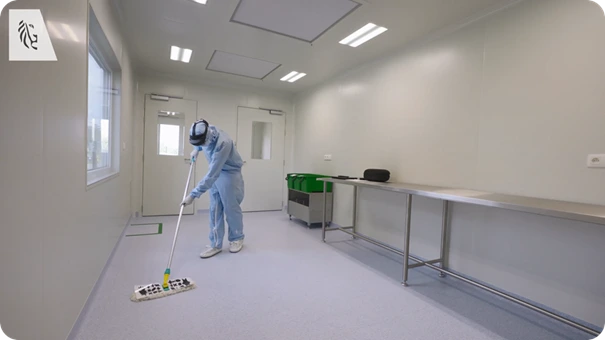
Surface cleaning sequence begins with ceilings and high surfaces, proceeds to walls and vertical surfaces from top to bottom, and ends with floors, working from the cleanest area toward the exit.
Equipment cleaning requires particular attention because equipment surfaces are often closest to the process and most likely to impact product quality.
Cleaning frequencies by cleanroom class
ISO 5 cleanrooms (Grade A/B)
ISO 5 cleanrooms (Grade A/B) typically require daily cleaning, with critical surfaces cleaned multiple times per day or between batches depending on the process.
ISO 6-7 cleanrooms (Grade C)
ISO 6-7 cleanrooms (Grade C) usually involve daily cleaning for high traffic areas and critical surfaces, with less critical areas cleaned several times per week.
ISO 8 cleanrooms (Grade D)
ISO 8 cleanrooms (Grade D) may have cleaning frequencies ranging from daily to weekly, depending on specific processes and contamination risks.
Frequencies should be established during cleanroom qualification and adjusted based on environmental monitoring data.

Personnel requirements and training
Cleaning personnel must be gowned appropriately for the cleanroom grade they are servicing. Training requirements often exceed those for regular cleanroom operators because cleaning activities can generate contamination if performed incorrectly. Personnel must understand both cleaning procedures and the impact of their activities on cleanroom performance, including airflow patterns and particle generation.
Documentation and compliance
All cleanroom cleaning activities require documentation including cleaning schedules, materials used, areas cleaned, personnel involved and any deviations from standard procedures. Environmental monitoring should include sampling before and after cleaning activities to verify that procedures maintain environmental conditions. Cleaning validation may be required to demonstrate consistent contamination control effectiveness.
Augmented reality in cleanroom cleaning
Ensuring consistent and verifiable cleanroom cleaning is a persistent challenge in controlled environments. To address this, the UHasselt Digital Future Lab, in collaboration with EAZER and ABN Cleanroom Technology and supported by XR-Innovation Funds from POM-Limburg, is currently developing CleanAR — an Augmented Reality application designed to guide cleaning operators through standardized procedures and track cleaning operations across entire sites.
By overlaying real-time guidance directly into the operator’s field of view, CleanAR aims to reduce human error and improve compliance — without requiring Wi-Fi or internet access on the production floor. The project is currently in active development, and we look forward to sharing further progress in the months ahead.
ABN's approach to cleanroom operations
ABN Cleanroom Technology’s Configure to Order Plus approach focuses on predictable performance through pre-engineered and validated building blocks. This systematic approach means compliance requirements can be embedded from the start rather than engineered separately for each project. The ADAPTUS Product Platform powers a fully data-driven process from design through delivery, supporting reliable cleanroom performance throughout the cleanroom lifecycle.
Effective cleanroom cleaning requires specialized materials, trained personnel and systematic procedures to ensure contamination control objectives are met consistently. It is a critical control point that protects product quality, regulatory compliance and reliable cleanroom performance.
Organizations should focus on establishing clear procedures, qualifying personnel and materials, and integrating cleaning activities with broader contamination control strategies. Proper cleanroom cleaning supports operational reliability throughout the facility lifecycle.