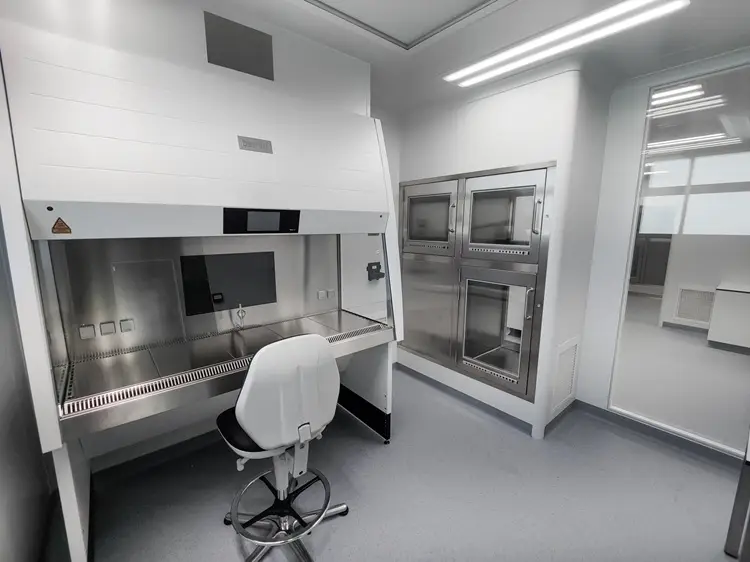
What if a cleanroom could provide continuous insight into its performance, help operators identify potential issues earlier and adjust its operating conditions when needed?
By combining IoT (Internet of Things) sensors, automated control systems and modular construction, smart cleanrooms offer a more connected approach to environmental monitoring, contamination control and facility management.
But what makes a cleanroom smart, and how does it work in practice?
Continuous environmental monitoring
Environmental monitoring is essential for understanding whether a cleanroom is operating within its specified conditions.
Depending on the application, a monitoring programme may include:
- Airborne particle concentrations
- Pressure differences between rooms
- Temperature and relative humidity
- Microbial contamination in the air and on surfaces
Connected sensors allow selected environmental parameters to be continuously measured and recorded through a central monitoring platform. Operators can access current and historical data, identify trends and receive alerts when defined limits are exceeded.
Microbiological monitoring requires appropriate sampling and detection methods and is not necessarily performed continuously through IoT sensors.
What does EU GMP Annex 1 require?
For sterile medicinal product manufacturing, EU GMP Annex 1 establishes specific expectations for environmental monitoring:
- Continuous particle monitoring in Grade A during critical processing.
- Continuous monitoring and recording of critical pressure differences.
- Warning systems to notify operators when critical pressure conditions are not maintained.
- Trend analysis to identify potential deterioration in environmental conditions.
However, monitoring alone cannot guarantee sterility. Effective contamination control starts with appropriate facility design, supported by operating procedures and a risk-based monitoring programme.
These elements come together in the Stratégie de contrôle de la contamination (CCS).
Automation: from monitoring to active control
Monitoring provides information about what is happening inside a cleanroom. Automation allows connected systems to respond to specific conditions within predefined operating limits.
Examples of cleanroom automation include:
- Door interlocking: Preventing simultaneous opening of airlock doors where required.
- Pressure control: Adjusting ventilation to maintain specified pressure differences.
- Alarm management: Notifying operators when monitored parameters exceed defined limits.
- Airflow control: Adjusting air change rates within qualified operating conditions.
Can automation reduce cleanroom energy consumption?
Cleanroom ventilation is an important contributor to energy consumption.
Instead of operating permanently at a fixed airflow rate, a suitably designed system can adjust airflow according to operational conditions.
This can reduce ventilation-related energy consumption, provided that the required cleanliness and environmental conditions are maintained.
In GMP environments, these operating strategies must be appropriately assessed, qualified and managed through change control.
Modular design: the physical foundation of a smart cleanroom
A smart cleanroom is more than a collection of sensors and software. Its physical construction plays an equally important role.
A well-designed cleanroom should support effective cleaning, controlled airflow, environmental monitoring and accessible maintenance.
Modular construction using standardised, pre-engineered components can help integrate these requirements from the beginning of a project.
For example, sensor mounting locations, cable routes, technical access points and air-handling components can be considered during the design phase.
This approach can support:
- Integration of monitoring and control systems.
- Consistency across different cleanroom areas.
- Accessibility for maintenance and calibration.
- Future modifications and facility expansions.
Any modification must still be assessed against the applicable qualification and regulatory requirements.
Using cleanroom data throughout the lifecycle
The value of environmental monitoring extends beyond daily operations.
Historical data can support technical and quality teams in understanding how a cleanroom performs over time and identifying changes that require further investigation.
| Monitored parameter | Practical application |
|---|---|
| Pressure difference | Identify changes in pressure stability |
| Particle concentration | Identify environmental trends and excursions |
| Filter pressure drop | Support filter maintenance planning |
| Temperature and humidity | Assess environmental stability |
| Consommation d'énergie | Identify potential efficiency improvements |
This information can support maintenance planning, investigations and qualification activities.
For sterile pharmaceutical manufacturing, EU GMP Annex 1 specifies maximum requalification intervals of:
- Grade A and B: Every 6 months.
- Grade C and D: Every 12 months.
Additional requalification may be necessary following significant changes or corrective maintenance.
Continuous monitoring supports these activities but does not replace formal qualification.
What should you consider when designing a smart cleanroom?
Monitoring and automation requirements should be considered early in the design process.
Before starting a cleanroom project, it is important to define:
- Monitoring requirements: Which environmental parameters need to be measured?
- Sensor locations: Where should measurements be taken based on contamination risks and airflow patterns?
- Alarm limits: When should operators be notified, and how should they respond?
- Automation requirements: Which operating conditions can be automatically controlled?
- Maintenance access: Can technical components be accessed without unnecessarily entering the controlled environment?
- Future flexibility: How can the cleanroom accommodate modifications or expansions?
These decisions help align the cleanroom’s physical design, monitoring systems and operational requirements.
Smart cleanrooms at ABN Cleanroom Technology
At ABN Cleanroom Technology, we bring cleanroom construction, air-handling technology and digital monitoring together through our Configure-to-Order Plus (CTO+) approach.
Our platform combines standardised, pre-engineered building blocks with project-specific requirements, supporting the integration of cleanroom systems from the design stage.
Our decentralised air-handling concept recirculates conditioned air and supports adjustable airflow strategies according to the project’s operational and qualification requirements.
Our cloud-based IoT monitoring platform connects cleanroom and HVAC sensors, providing remote access to environmental data, historical trends and alerts.
Together with our maintenance and validation services, these technologies support cleanroom performance throughout the facility’s lifecycle.
A more connected approach to cleanroom performance
A smart cleanroom combines appropriate physical design, environmental monitoring and automated control to support contamination control, operational reliability and energy efficiency.
The objective is not simply to collect more data, but to use relevant information to make better-informed operational decisions.
Planning a new cleanroom or upgrading an existing facility? Contact our team to explore how monitoring, automation and modular design can be integrated into your project.